Building Practical AI Skills with ChatGPT for Beginners
The first time someone opens a chat interface and sees a blinking cursor waiting for input, a quiet tension often settles in. The technology looks simple enough—a text box, a send button, and a blank conversation. But beneath that minimal surface lies a language model capable of generating essays, debugging code, drafting business plans, and even simulating dialogues with historical figures. For someone who has never worked with artificial intelligence, the gap between seeing that empty box and knowing what to type can feel surprisingly wide. This is precisely the moment when a structured, beginner-friendly resource makes all the difference. A guide like ChatGPT for Beginners exists to bridge that gap, not by overwhelming readers with technical jargon, but by walking them through the process one step at a time.
Why a Beginner’s Blueprint Matters in the Age of AI
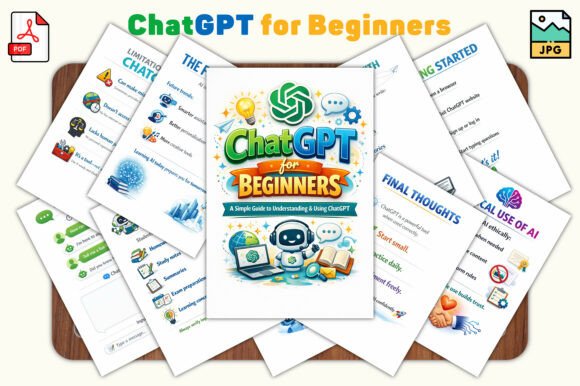
Artificial intelligence has entered the mainstream faster than almost any previous technology. Unlike learning a programming language or mastering a complex software suite, using a conversational AI does not require years of study. The barrier to entry is low, but the barrier to effective use is higher than many expect. Without guidance, new users often fall into common traps: asking overly vague questions, expecting human-like reasoning in areas where the model has clear limitations, or assuming the output is always accurate. A focused resource such as ChatGPT for Beginners addresses these challenges head-on. It provides a framework that transforms a potentially frustrating trial-and-error process into a deliberate, confidence-building practice. The e-book’s thirty pages are designed to be consumed in a single sitting or revisited as needed, making it an ideal companion for anyone who wants to move from curious observer to competent user without feeling lost.
Demystifying How ChatGPT Actually Works
One of the most valuable sections in any beginner guide is the explanation of what happens under the hood—not in a technical deep-dive sense, but in a way that sets realistic expectations. The average user does not need to understand transformer architectures or tokenization algorithms. What they do need is a clear mental model of how the AI processes input and generates responses. ChatGPT for Beginners takes exactly this approach. It frames the AI as a pattern-matching engine trained on vast amounts of text, which predicts plausible continuations based on the prompt it receives. This simple explanation immediately clarifies why the model sometimes produces confident-sounding but incorrect answers, and why careful phrasing of a prompt matters so much. Readers come away with a practical understanding: the AI has no consciousness, no intent, and no memory beyond the current conversation window unless explicitly managed. That understanding forms the bedrock of every successful interaction that follows.
Prompting as a Skill, Not a Mystery
Writing a good prompt is arguably the most important skill a ChatGPT user can develop. Beginners often assume that the AI will interpret their intent regardless of how they phrase their request. In reality, the quality of the output is tightly coupled to the clarity and specificity of the input. ChatGPT for Beginners dedicates substantial attention to prompt design, offering examples that range from simple factual queries to multi-step creative tasks. A common example in the book shows the difference between asking “Tell me about marketing” and requesting “Explain three content marketing strategies for a small bakery, including an example of each.” The second prompt yields actionable, structured information; the first yields a generic paragraph that could apply to any industry. By demonstrating this contrast, the e-book helps readers internalize a principle they can apply across every domain they explore—whether that’s generating social media copy, drafting a research outline, or brainstorming product names.
Mapping Use Cases Across Different Audiences
The versatility of ChatGPT means that its value changes depending on who is using it. A student has different needs than a freelancer, and a business owner faces different challenges than a hobbyist writer. The strength of a well-designed beginner guide lies in its ability to speak to this diversity without fragmenting into irrelevance. ChatGPT for Beginners achieves this by presenting use cases in categories that resonate across roles. For students, the e-book covers summarizing lecture notes, generating flashcards, and simulating study questions. For entrepreneurs, it walks through drafting customer emails, refining value propositions, and analyzing competitor messaging. For content creators, it offers strategies for overcoming writer’s block, repurposing long-form content into shorter formats, and maintaining a consistent tone across pieces. This breadth ensures that no matter who picks up the guide, they will find scenarios that mirror their own work or interests.
- Students and lifelong learners can use ChatGPT to break down complex topics, generate practice problems, or request explanations in simpler language.
- Freelancers and gig workers can automate proposal drafts, polish client communications, and brainstorm service packages.
- Entrepreneurs and small business owners can generate marketing copy, draft blog posts, and create standard operating procedures.
- Content creators and writers can develop story ideas, edit drafts, and produce captions or headlines at scale.
- Hobbyists and curious explorers can learn new topics, get book recommendations, or even co-create fictional stories.
Each of these groups benefits from the same foundational skills, but the application differs. A guide that acknowledges those differences without forcing the reader into a one-size-fits-all template is far more likely to be used repeatedly. That repeat engagement is exactly what builds lasting AI literacy.
Productivity Gains Through Structured Interaction
One observation that emerges quickly among consistent ChatGPT users is that the tool is only as productive as the workflow supporting it. A person who opens a chat, types a single question, and copies the response has not truly integrated AI into their process. The real gains come when users learn to iterate, refine, and combine outputs. ChatGPT for Beginners introduces a conversational workflow that encourages this iterative approach. It suggests starting with a broad request, reviewing the output, then asking for revisions or expansions. For example, a user might first ask for a list of blog post ideas, then select one idea and request an outline, then ask for a first paragraph written in a specific tone. Each step builds on the previous one, and the user remains in control of direction and quality. This method transforms ChatGPT from a one-shot answer generator into a collaborative partner in thinking and creation.
Overcoming the Blank Page Problem
Many creative professionals struggle with the proverbial blank page—the moment when a project requires starting from nothing. ChatGPT excels at providing that initial spark, but only if the user knows how to prompt for it. The e-book offers specific techniques for breaking inertia: asking for “ten unconventional angles on X,” requesting “a dialogue between two experts debating Y,” or generating “a metaphor that explains Z to a child.” These prompts are concrete, repeatable, and immediately applicable. A blogger stuck on a topic can generate multiple headline variations in seconds. A graphic designer brainstorming visual concepts can describe a mood and ask for symbolic associations. The underlying skill is the same: using the AI to produce raw material that the human then evaluates, selects, and refines. The book makes this process visible and teachable.
Recognizing Limitations and Using AI Responsibly
No guide for beginners would be complete without addressing the limitations and ethical considerations of AI. Enthusiastic new users sometimes anthropomorphize the model, assuming it understands context, remembers past conversations, or possesses opinions. Others may treat every output as factual, unaware that ChatGPT can fabricate citations, misrepresent statistics, or reinforce biases present in its training data. ChatGPT for Beginners tackles these issues directly. It explains that the model has no access to real-time information unless connected to a browsing tool, that it can produce plausible-sounding falsehoods, and that users bear responsibility for verifying critical information. The e-book also touches on privacy considerations, advising readers not to share sensitive personal data within prompts. By framing these limitations as features of the technology rather than failures, the guide helps readers develop a healthy skepticism that improves their overall experience. A user who understands when not to trust the AI is ultimately more effective than one who trusts it blindly.
Ethical Use in Professional and Academic Contexts
The conversation around AI ethics often focuses on high-level concerns about bias, job displacement, and regulation. But for an individual user, ethical questions arise in everyday decisions: Is it acceptable to use AI to write a school essay? Should a freelancer disclose that they used AI to draft a client proposal? ChatGPT for Beginners does not impose a single answer but instead equips readers with principles they can adapt to their own contexts. It encourages transparency in professional work, especially when AI-generated content is submitted as original. It suggests that students check their institution’s policies and use the AI as a tutor rather than a ghostwriter. And it emphasizes that the human must always remain the final decision-maker. These guidelines are practical rather than preachy, which makes them more likely to be adopted. The goal is not to restrict usage but to ensure that it remains honest, constructive, and aligned with the user’s own values.
Building Long-Term Confidence Through Repetition
True confidence with any tool comes from repeated, successful use. A guide that covers everything in theory but leaves the reader without a clear next step has only done half the job. ChatGPT for Beginners includes hands-on prompts, exercises, and reflection points that encourage immediate application. A student can finish a chapter on study aids and within minutes generate a set of practice questions for an upcoming exam. An entrepreneur can read about marketing copy and immediately draft a product description. The feedback loop is short, which reinforces learning and builds momentum. Over time, the user internalizes the patterns of effective prompting, develops an intuition for what the AI handles well, and learns to recognize situations where traditional research or human expertise is still necessary. That nuanced judgment is the hallmark of genuine AI literacy, and it is exactly what a well-constructed beginner guide cultivates.
From Beginner to Competent Practitioner
The transition from beginner to competent practitioner is not marked by memorizing a set of commands or mastering a particular workflow. It is marked by a shift in mindset. The beginner sees ChatGPT as a black box that sometimes delivers miracles and sometimes delivers nonsense. The competent practitioner sees it as a probabilistic text generator with known strengths and weaknesses, and they adjust their behavior accordingly. They write prompts with structure, verify outputs with skepticism, and iterate with purpose. They also know when not to use AI—for tasks requiring empathy, subjective judgment, or verified factual accuracy. Resources like ChatGPT for Beginners accelerate this shift by providing the vocabulary, the examples, and the practice framework that turn abstract concepts into usable skills. The thirty-page structure is compact by design, recognizing that most learners do not want a textbook; they want a map that shows them where to go and how to start moving.
Practical Observations from Real Usage Patterns
Observing how people actually use ChatGPT in daily life reveals patterns that are not always obvious from feature lists or marketing materials. One recurring observation is that new users tend to under-specify their requests. They ask for “help with my resume” and receive a generic list of tips, when what they really wanted was “rewrite my resume summary for a data analyst role using metrics.” Another pattern is that users often give up after a single unsatisfactory response, not realizing that a small clarification or a different angle can produce dramatically better results. A good beginner guide trains readers to expect iteration and to treat the first response as a draft rather than a final answer. That shift alone can double or triple the perceived usefulness of the tool. The e-book’s examples explicitly contrast one-shot prompts with iterative exchanges, showing how a conversation that extends over several turns yields richer and more tailored outcomes.
- One-shot prompt: “Write a cover letter for a marketing job.” Response is generic and forgettable.
- Iterative prompt: “Write a cover letter for a marketing job at a sustainable fashion brand. Mention my experience with email campaigns and social media analytics.” Better, but still broad.
- Refined iteration: “Take that draft and make it more direct. Shorten each paragraph to three sentences maximum. Add a line about my specific results with a past campaign.” The final output is tight, personalized, and useful.
This kind of step-by-step refinement is exactly what a learner needs to see modeled. Reading about iteration is helpful; watching a concrete example unfold across revisions is transformative.
The Role of a Guide in a Rapidly Evolving Landscape
AI tools evolve quickly. Prompts that worked six months ago may need adjustment after a model update. Features like code interpretation, image generation, and voice interaction expand the possible use cases almost monthly. In this environment, a static guide risks becoming outdated. ChatGPT for Beginners avoids that trap by focusing on durable principles rather than ephemeral features. The core skills—clear prompting, iterative refinement, output verification, ethical judgment—remain relevant regardless of which version of the model is active or which UI is in use. The e-book positions itself as a foundation, not a final word. Readers who internalize its lessons are prepared to adapt as the technology matures. They learn to experiment, to read update notes, and to transfer their skills to new interfaces. In that sense, a beginner guide that teaches principles rather than recipes offers the highest return on investment. It does not expire.
Choosing the Right Starting Point
For anyone who has been curious about ChatGPT but hesitant to begin, the biggest obstacle is usually not a lack of interest—it is a lack of structure. The internet is full of YouTube tutorials, blog posts, and Twitter threads, but they vary wildly in quality and perspective. Some assume too much prior knowledge. Others focus on advanced use cases that overwhelm a newcomer. A dedicated, self-contained resource like ChatGPT for Beginners solves this problem by providing a single coherent path from zero competence to functional independence. The reader does not need to hunt for information across multiple sources or wonder which advice to trust. Everything is presented in a logical sequence, written in accessible language, and designed to produce immediate results. The combination of explanation, example, and exercise creates a learning loop that is both efficient and enjoyable. For students, freelancers, entrepreneurs, and creatives who want to use AI with genuine confidence, that structure is the difference between dabbling and mastery.