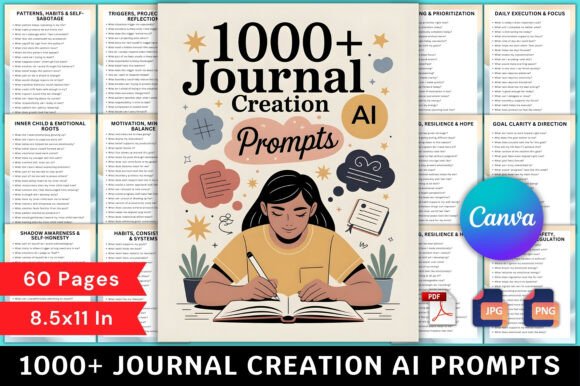
1000 Journal Creation AI Prompts
Prompts are the quiet engine behind almost every meaningful journaling habit. A single well-placed question can shift a vague feeling into a clear insight, or turn a scattered morning into a focused day. The 1000 Journal Creation AI Prompts collection takes this idea and expands it into a full ecosystem of self-reflection, planning, and creative exploration. Whether you build journals for others or use them for your own growth, this set offers depth without rigidity, and structure without pressure. It is designed to be flexible enough for daily use, yet rich enough to power professional product creation.
What Makes This Prompt Collection Different
Most prompt lists fall into one of two traps. They are either too generic—asking surface-level questions that produce shallow answers—or too narrow, focusing on a single niche like gratitude or goal setting. This collection avoids both extremes. It includes ten distinct sections that span deep self-reflection, daily layouts, goal clarity, mental health support, creative niche ideas, and more. Each section is built around a specific life area, so users can move between emotional check-ins, habit tracking, and long-term planning without feeling like they are switching between unrelated systems.
The prompts are also repeatable by design. Morning intention questions, evening reflections, and focus planning layouts can be used daily without becoming stale because they target different layers of experience each time. A question like “What emotion is most present for me right now?” lands differently on a high-energy morning than on a tired afternoon, and that variability keeps the practice alive.
For Creators and Designers
If you create journals, planners, workbooks, or digital products, this collection works as a ready-made content library. You can pull prompts directly from the sections and arrange them into themed products without starting from scratch. For example, a 30-day shadow work journal can be assembled using prompts from the Deep Self-Reflection and Creative Niche Journal Ideas sections. A weekly productivity planner can be built using the Goal Clarity and Daily Repeatable Layouts prompts.
You can also layer prompts to match specific audiences. A journal aimed at new mothers might combine emotional regulation prompts with goal-setting questions around rest and identity. A planner for freelancers could blend focus planning with boundary-setting and financial reflection prompts. The key is to treat the collection as a modular resource rather than a fixed script. Mix, reorder, and adapt to fit the tone and format of your product.
Customization Without Complexity
Because the prompts are written in plain, direct language, they are easy to reformat. You can keep them as standalone questions, combine them into guided exercises, or add your own introductory paragraphs. If you design printable planners, you can place one prompt per page with space for written responses. If you build digital apps or Notion templates, you can use the prompts as daily or weekly prompts that rotate automatically. The flexible undated structure means users never feel behind, which is especially important for products aimed at people who struggle with consistency.
For Personal Growth and Self-Reflection
Individual users will find that the collection covers the full arc of inner work. The identity prompts help you examine who you are beneath your roles and routines. The healing prompts invite you to look at past experiences without forcing closure. The habit questions are practical without being moralistic—they ask about what works, what gets in the way, and what small changes feel sustainable.
One of the most useful sections is the Emotional Check-In prompts. These are not about labeling emotions as good or bad. They ask about physical sensations, triggers, and the stories you attach to certain feelings. Over time, this builds a vocabulary for emotional experience that makes it easier to regulate mood and respond to stress with intention rather than reaction.
Healing and Recovery Work
Niche prompts for shadow work, inner child exploration, and breakup healing are included, but they are integrated into the broader structure rather than isolated as special topics. This matters because healing is not a separate category of life—it runs through everything. A prompt about setting boundaries might appear in the mental health section, but it also connects to goal clarity and daily planning. The collection respects that real growth is interconnected.
For someone going through a life transition—career change, divorce, relocation—the prompts offer a way to check in without pressure. You can skip entire sections and focus only on the questions that feel relevant. The design encourages this flexibility. There is no wrong way to move through the material.
Productivity That Feels Human
Productivity prompts often lean toward hustle culture language—crush your goals, optimize your time, maximize your output. The prompts here take a different approach. They ask about meaningful progress rather than volume. The goal clarity section includes questions about values alignment, energy management, and the difference between urgency and importance. The habit-building prompts focus on consistency over intensity, and the progress tracking questions celebrate small wins as much as major milestones.
This makes the collection suitable for people who are burned out by traditional productivity systems. It reframes planning as a supportive practice rather than a performance metric. For entrepreneurs and small business owners, this is especially valuable because it separates healthy ambition from chronic overwork.
Adapting for Different Audiences
If you are a coach, educator, or group facilitator, you can use the prompts in workshops or one-on-one sessions. The structured sections make it easy to find relevant questions without scrolling through unrelated content. For example, a session on emotional regulation can draw directly from the Mental Health Emotional Awareness section. A goal-setting workshop can pull from the Goal Clarity Productivity Support prompts. The language is clear enough that participants can use the prompts independently after the session ends.
Marketers and content creators can also use the prompts as social media content. A single thought-provoking question posted on Instagram or LinkedIn can generate engagement and start conversations. You can build a series around one section—like a week of morning intention prompts or a month of shadow work questions—and link back to the full collection as a resource.
Staying Organized Without Losing Creativity
One challenge with a large prompt collection is knowing where to start. The well-organized sections help, but it helps to have a simple system. If you are using the prompts for your own journaling, try picking one section per week. Spend seven days with the emotional check-in prompts, then move to goal clarity the next week. This keeps the practice fresh without overwhelming you with choices.
If you are building a product, map out your customer’s journey first. What emotional state are they in when they buy your journal? What do they need most in the first week of use? Use the prompts to support that journey step by step. For example, a journal for anxiety management might start with regulation and self-compassion prompts, move into boundary-setting, and end with goal-setting for a calmer life. The sequence matters as much as the individual questions.
Keeping Content Original and Audience-Friendly
When using AI-generated prompts, there is always a risk of generic language. The prompts in this collection are written to feel human and direct, but you can deepen originality by adding your own voice. Rewrite a prompt to match your brand tone. Add a personal example or a short reflection before the question. Combine two prompts into a mini-exercise. Small edits make a big difference in how the content lands with readers.
For digital products, consider adding space for drawing, mind mapping, or free writing alongside the prompts. Not everyone processes through linear writing. Visual and spatial responses can unlock insights that words alone might miss. The prompts are flexible enough to support these alternative formats.
Practical Recommendations for Getting Started
If you are new to using structured prompts, begin with the Daily Repeatable Layouts section. These are designed for morning and evening use and build a natural rhythm. After a week or two, add prompts from one other section that matches your current focus—whether that is emotional awareness, habit building, or creative exploration. Avoid the temptation to use all sections at once. Depth comes from repetition, not volume.
If you are creating a product, test your prompt selections with a small group before launch. Ask users which questions resonated and which felt redundant. Use their feedback to refine your layout and prompt order. A well-tested journal has a much higher chance of becoming a daily habit for its users.
The 1000 Journal Creation AI Prompts collection is not a quick fix or a magic solution. It is a tool for consistent, meaningful engagement with yourself or your audience. Used well, it becomes a framework for clarity, creativity, and calm intention. Start small, stay curious, and let the prompts do the work of guiding you deeper.