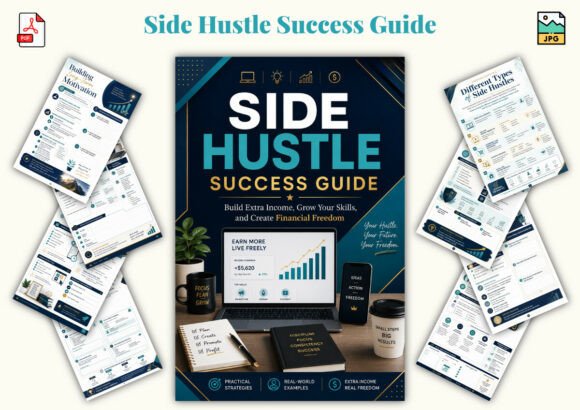
The Side Hustle Success Guide: Your Blueprint for Building Skills, Income, and Financial Freedom
In today’s rapidly shifting economy, the concept of a single income stream feels increasingly fragile. Professionals, creatives, and entrepreneurs alike are seeking ways to diversify their earnings, explore passions, and build a financial safety net. The Side Hustle Success Guide emerges as a thoughtfully crafted resource designed to bridge the gap between aspiration and execution. This 30-page workbook, with its modern aesthetic and practical exercises, offers a structured path for anyone ready to turn ideas into tangible income. It is not just a collection of pages; it is a systematic approach to skill development, income growth, and long-term financial autonomy.
Understanding the Core of the Side Hustle Success Guide
At its heart, the Side Hustle Success Guide functions as an interactive educational workbook. It moves beyond generic advice by providing concrete tools for planning, branding, marketing, and financial management. The guide is divided into actionable sections that address the most common challenges fledgling business owners face: from overcoming inertia to scaling a micro-enterprise. Each page is designed to provoke thought and inspire action, making it suitable for both those who have never considered a side venture and experienced freelancers looking to refine their operations.
What Sets This Workbook Apart
Unlike many digital products that merely compile tips, this guide emphasizes interactivity. It includes worksheets for goal setting, habit tracking, and money management. The inclusion of both JPG and PDF files enhances its utility across devices and workflows. Whether accessed on a tablet for brainstorming during a commute or printed for a focused planning session, the content remains accessible and engaging. The clean typography and modern creator-business theme reduce cognitive load, allowing users to concentrate on strategic thinking rather than deciphering layout.
A key characteristic of the guide is its beginner-friendly yet comprehensive nature. It does not assume prior business knowledge, yet it offers depth for those who have already started. For example, the branding and marketing sections cover foundational concepts like identifying target audiences and crafting value propositions, while also introducing growth tactics such as content pillars and social media engagement loops. This layering makes the Side Hustle Success Guide a scalable resource that grows with the user's confidence.
Who Can Benefit from a Structured Side Hustle Workbook
The audience for a resource like this is remarkably broad. Professionals working full-time jobs may use it to plan a weekend consultancy or e-commerce store. Creators—writers, designers, photographers—can leverage the productivity habit pages to balance client work with personal projects. Educators and researchers often require diversified income for grant-independent research; the financial planning sections help them allocate earnings toward sabbaticals or equipment. Even hobbyists who wish to monetize crafts or coding find value in the goal-setting worksheets that transform loose ideas into quarterly milestones.
Small business owners already operating a venture can revisit the guide to diagnose bottlenecks. For instance, a local baker using social media for sales might use the marketing strategy pages to analyze which platform yields the highest return on time. The guide’s emphasis on productivity habit building helps such owners systematize daily tasks, reducing burnout. Likewise, online sellers on platforms like Etsy or Amazon can use the income tracking templates to separate business expenses from personal funds, a critical step for tax preparation and profit analysis.
Key Features and Their Real-World Applications
The Side Hustle Success Guide contains 31 professionally designed pages. Each page serves a distinct purpose within the side hustle lifecycle. Below is an exploration of several features and how they translate into practical advantages.
Goal Setting and Productivity Habit Worksheets
One of the initial hurdles in starting a side hustle is vagueness. Many people say they want "more income" but lack a tangible target. The goal-setting worksheets in this guide lead users through a process of defining specific, measurable objectives. For example, instead of "earn extra money," a user might write "generate $500 per month via freelance writing by securing three recurring clients within 60 days." The productivity habit pages then break this down into daily actions: spend 30 minutes pitching, write one sample article, follow up on leads each Tuesday. This structure turns ambition into a manageable workflow.
Marketing Strategies and Social Media Growth Guidance
Marketing can feel overwhelming, especially for those who are new to the creator economy. The guide demystifies this via step-by-step planning templates. A user running a side hustle selling digital planners can use the social media growth section to identify their ideal customer—busy moms, students, or corporate professionals—and tailor content accordingly. The branding business building pages encourage consistency in visual identity and messaging, which builds trust. Observations from successful side hustlers indicate that those who systematically plan their content calendars see faster audience growth, and this workbook formalizes that often intuitive process.
Money Management and Financial Planning Pages
Financial mismanagement is a common reason side hustles fail to scale. The guide’s money management tips include templates for tracking income, expenses, and profit margins. For instance, a user offering coaching services can input session fees, platform commissions, and marketing costs to see their net per session. The financial planning pages also prompt users to set aside funds for reinvestment—such as upgrading software or attending a conference—and emergency savings. This foresight prevents the feast-or-famine cycle that plagues many freelancers.
Advantages of Using a Structured Workbook for Side Hustle Development
Adopting a structured workbook like the Side Hustle Success Guide offers several advantages over ad-hoc learning or scattered resources. First, it provides cognitive offloading: by externalizing plans and ideas onto paper (or a digital file), users free mental energy for execution. Second, the sequential layout ensures no critical step is missed. Many beginners focus exclusively on product creation and neglect market research or customer retention; the guide forces a balanced perspective by covering the entire value chain.
Another advantage is accountability. Habit tracking worksheets and monthly review pages encourage regular reflection. A user can see whether they actually followed their marketing calendar or if income targets were met. This self-accountability is more sustainable than relying on external coaches or expensive courses. Additionally, the guide’s design—6x9 inches, high-quality layout, readable typography—enhances user experience. When a resource is pleasant to handle, engagement increases. This is especially true for digital creators who appreciate aesthetic consistency in their tools.
Comparing the Workbook to Other Approaches
Consider the alternative: browsing endless blog posts or YouTube tutorials, piecing together advice from dozens of sources. This often leads to information overload and analysis paralysis. In contrast, the Side Hustle Success Guide consolidates best practices into a single, coherent framework. It acts as a one-stop reference that users can revisit quarterly. For example, a freelancer might complete the initial planning pages in January, then return to the productivity section in April after taking on too many projects, rebalancing their habits to prevent burnout.
The interactive worksheets also differentiate this guide from standard e-books. While e-books deliver information passively, the workbook demands active participation. Writing down answers, filling budget sheets, and sketching brand mood boards engage multiple learning modalities—visual, kinesthetic, textual—which improves retention. This is particularly beneficial for hobbyists and researchers who may not have a business background but are methodical in their approach.
Considerations for Maximizing the Guide’s Impact
To fully leverage the Side Hustle Success Guide, users should approach it with a commitment to consistency. Simply downloading the file will not yield results; the value unfolds through repeated use. It is advisable to schedule a weekly session—say, Sunday evenings—to review progress, update worksheets, and set priorities for the coming week. The guide can be used digitally in apps like GoodNotes or Notability for those who prefer typing, or printed for those who like manual journaling. The decision depends on workflow comfort.
Another consideration is integration with existing tools. Users who already employ project management software (e.g., Trello, Asana) or digital calendars can align the guide’s goal-setting pages with those systems. For instance, milestones from the workbook can be transferred to a calendar with reminders. The financial planning section complement tools like QuickBooks or spreadsheet templates, offering a high-level overview before diving into granular tracking. The guide is not meant to replace other resources but to serve as a foundational strategic document.
Observations from the creator economy indicate that side hustles evolve. What starts as a weekend project may become a primary income source. The guide accommodates this growth through its focus on scalability. The branding business building pages encourage users to think about systems—how to delegate, automate, or expand product lines—so that the hustle can transition from survival mode to sustainable enterprise. Users should revisit the entire workbook every six months to adjust strategies based on market changes or personal goals.
Real-World Examples of Guide Application
Consider a graphic designer working a corporate job who wants to build a freelance clientele. Using the Side Hustle Success Guide, she begins with the side hustle planning page, setting a goal of $1,000 monthly freelance income within four months. The marketing strategies section helps her identify local businesses as clients and craft a pitch template. The productivity habit pages remind her to dedicate two evenings per week to outreach. By month three, she has secured three regular clients, and the money management pages show her exactly how to price her services for profitability. The guide becomes her operational backbone.
Another example involves a stay-at-home parent who creates educational worksheets for children. He uses the social media growth guidance to build an Instagram following, sharing tips and previews. The goal-setting worksheets help him decide to launch a paid subscription newsletter by a specific date. As income trickles in, the financial planning pages track earnings against expenses for materials and advertising. The interactive nature of the workbook keeps him engaged even when motivation wanes, because he can see progress quantified.
For an educator seeking to supplement income through online courses, the guide provides a bridge between pedagogy and commerce. The branding section helps define a teaching persona while the marketing strategies suggest segmentation: targeting fellow teachers or parents. The productivity habit building ensures he blocks time for course creation without neglecting his main job. The Side Hustle Success Guide thus adapts to diverse side hustle types—service-based, product-based, or content-driven—making it a versatile asset.
The Role of the Guide in Today’s Creator Economy
The creator economy has democratized income generation, but it also fosters fierce competition. Quality content and unique offerings are table stakes; strategic planning is the differentiator. The Side Hustle Success Guide equips users with the strategic thinking necessary to carve a niche. Its modern creator-business theme reflects the aesthetic expectations of audiences on platforms like TikTok, YouTube, and Substack. By aligning its design with current trends, the guide itself models good branding practices.
Moreover, the guide emphasizes an ethical approach to side hustling. The money management pages include prompts for transparent pricing, budgeting for taxes, and avoiding predatory gig work. This aligns with E-E-A-T principles by prioritizing user welfare over hype. The guide does not promise overnight riches; it advocates for consistent effort, skill development, and gradual income growth. This realistic framing builds trust with users who have been disappointed by get-rich-quick schemes.
Conclusion of Insights (Not a Formal Conclusion)
Throughout this exploration, it becomes evident that the Side Hustle Success Guide is more than a product—it is a methodology. Its interactive worksheets, financial templates, and marketing frameworks offer actionable pathways for building supplementary income. Whether the user is a professional pivoting careers, a creator scaling a brand, or a hobbyist exploring monetization, the guide provides a low-friction entry point into structured business planning. The combination of motivational exercises and practical tools ensures that users not only dream but also do. In a world where financial uncertainty is the norm, having a reliable compass for side hustle success is invaluable.
Ultimately, the value of this workbook lies in its execution. Those who commit to completing its pages, revisiting its strategies, and applying its insights to their unique contexts will find themselves equipped to navigate the complexities of the modern gig economy. The Side Hustle Success Guide stands as a testament to the power of thoughtful design applied to personal and professional growth.