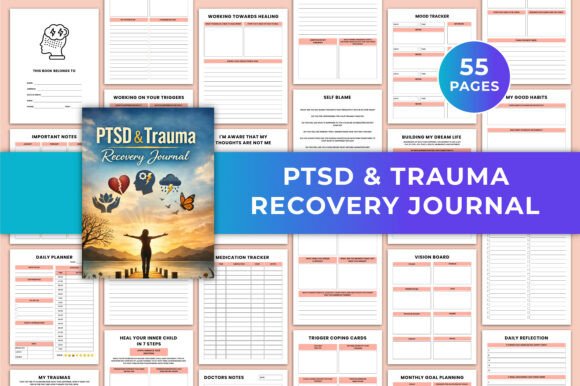
PTSD Trauma Recovery Journal KDP: A Practical Tool for Real Healing
If you are in the middle of trauma recovery, you know that healing is rarely a straight line. Some days feel manageable, others hit like a wall. You look for tools that actually fit your life, not just generic advice that sounds good on paper. This is where the PTSD Trauma Recovery Journal KDP steps in — not as a rigid workbook, but as a flexible, customizable companion that adapts to where you are right now.
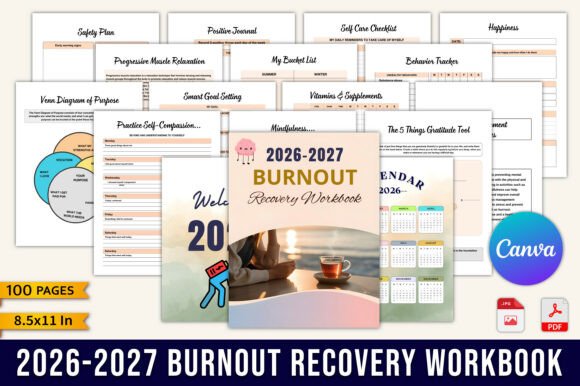
It comes as a fully editable Canva template, which means you can change fonts, colors, and layout to make it feel like yours. That matters more than you might think. When you are working through trauma, the tool itself should not feel like another obligation. It should feel like a space you want to return to.
What This Journal Actually Does in Real Life
This is not a journal that asks you to write three pages of stream-of-consciousness every morning. It is structured to support the specific, often messy, work of trauma processing. Inside, you will find trauma acknowledgment and processing worksheets that help you name what happened without forcing you to relive it in a way that feels retraumatizing. The trigger processing and pattern recognition pages let you map out what sets off a reaction and notice patterns over time — something that becomes incredibly useful when you are trying to make sense of why certain situations hit harder than others.
There is also a guided section called “Heal Your Inner Child in 7 Steps.” This is not fluffy language. It is a structured way to revisit younger parts of yourself that may still be carrying shame, fear, or self-blame. The self-blame and self-compassion reflection exercises give you a place to work through the “it was my fault” loop that so often keeps trauma survivors stuck. You might find yourself using this section after a difficult memory surfaces or when you notice that familiar wave of guilt rising again.
Where People Actually Use This Journal
The beauty of a customizable template is that it shows up differently depending on your life. Here are a few real-world scenarios where this journal becomes more than just a notebook.
- After a therapy session: You just had a heavy session. Your therapist asked you to track your emotions between appointments. The anxiety and anger mood trackers make this concrete. You can jot down where you were, what triggered the spike, and what helped. Over a few weeks, patterns emerge that you and your therapist can actually work with.
- During a trigger episode: When you feel that familiar surge of panic or anger, the decatastrophizing worksheet gives you a structured way to slow down the spiral. It walks you through what you are fearing, what is actually happening, and what you can do. It is not magic, but it creates a pause — and that pause is often enough to shift the trajectory.
- When grief or loss resurfaces: Trauma and grief are often tangled. The grief and loss processing pages allow you to sit with the loss without needing to fix it. You might use them on anniversaries, after a conversation that reopened a wound, or just when the weight shows up uninvited.
- For medication and appointment tracking: If you are managing medication, therapy appointments, or doctor visits, the medication and therapy appointment logs keep everything in one place. You can also note how you felt during the visit, which is useful for follow-ups.
- For goal setting that actually respects your capacity: The goal planning and habit development pages are designed for people whose energy fluctuates. You are not asked to set massive goals. Instead, you break down what is realistic this week. The to-do structured planning pages help you prioritize without overwhelming yourself.
Different Users, Different Entry Points
Someone with complex PTSD may gravitate toward the trigger processing and pattern recognition pages because their triggers are layered and often confusing. A survivor of a single traumatic event might find the trauma acknowledgment worksheets most useful at the start, then move into the self-worth and self-love affirmation sections later on. A person who is further along in their recovery might focus on the vision board and dream life planning pages, using the journal to rebuild a sense of future that trauma stole.
There is also a real benefit for people who are in group therapy or peer support settings. The coping strategy and trigger coping cards can be used as conversation starters. You can bring a completed worksheet to a session and say, “This is what I noticed this week.” It gives you language for experiences that are often hard to articulate.
If you are a therapist, you might recommend this journal to clients who need a structured way to practice between sessions. Because it is a Canva template, you could even customize sections to match your therapeutic approach. That flexibility is rare in pre-printed workbooks.
What to Consider Before You Start
No journal does the healing work for you. This one is a framework, not a cure. If you are in the middle of a crisis or experiencing severe symptoms, this should sit alongside professional support, not replace it. The doctor visits and mental health notes section is there precisely because this tool works best when you are also connected to care.
Another consideration is consistency. The journal is comprehensive, and that can feel overwhelming if you try to use every page at once. It is better to start with one section that matches what you are currently struggling with — maybe the anxiety tracker or the decatastrophizing worksheet — and let the rest wait until you need them. There is no deadline. There is no wrong way to use it.
Because it is a Canva template, you will need basic familiarity with editing. You do not need to be a designer, but you should be comfortable dragging text boxes, changing colors, and downloading your customized version. If you prefer a print-and-go option, you can customize it once with your preferred fonts and colors, then print it out as many times as you need.
Strengths That Stand Out
- Adaptability: You are not locked into someone else's design. You can make it minimalist, colorful, or anything in between. That personalization makes it more likely you will actually use it.
- Real trauma-informed structure: The sections are not randomly thrown together. They follow a logical progression from acknowledgment to regulation to rebuilding. That matters when you are navigating something as layered as trauma.
- Practical detail: The medication logs, appointment notes, and mood trackers are not afterthoughts. They are integrated into the recovery process, which is helpful for people who need to see the connection between their daily habits and their emotional state.
- Inner child work made accessible: The “Heal Your Inner Child in 7 Steps” section is structured enough to guide you but flexible enough to adapt to your own timeline. Some people spend weeks on one step. Others move through it more quickly. Either way, it is there when you are ready.
Limitations to Keep in Mind
No tool is perfect. If you are someone who struggles with structure, the sheer number of pages might feel daunting. That is okay — start small. Pick two or three pages and ignore the rest until they call to you. Also, because it is a digital template, you need to be comfortable editing on your device. If you prefer a physical notebook you can grab at any moment, you will want to print out your customized version and keep it accessible.
Another honest note: trauma recovery is not linear. Some weeks you will fill out every page. Other weeks you will not open the journal at all. That is normal. The journal does not judge you for gaps. It is built to be picked up whenever you are ready.
How to Get the Most Out of It
Think of this journal as a co-pilot, not a commander. Use the daily, weekly, and monthly reflection pages to check in with yourself — not to perform wellness, but to actually see where you are. The vision board and dream life planning sections are not about toxic positivity. They are about giving yourself permission to imagine a life beyond survival. That can be terrifying and hopeful at the same time, and the journal holds space for both.
The self-worth and self-love affirmation sections might feel awkward at first. Many trauma survivors have a deep resistance to affirmations because they feel untrue. If that happens, you can use those pages to write down what you want to believe, even if you do not believe it yet. Over time, that gap often shrinks.
Whether you are new to recovery or have been at it for years, this PTSD Trauma Recovery Journal KDP offers a container for the work that does not demand you be anywhere other than where you are. It is practical, editable, and built for real life — not for a highlight reel. If you are looking for a tool that meets you where you are, this one is worth exploring.