Alphabet Tracing for Preschoolers: Building Early Writing Skills Through Playful Practice
Every parent and educator knows that the journey to literacy begins with a single stroke. Before children can write their names or read their first words, they need to develop the foundational skills that make those milestones possible. This is where Alphabet Tracing for Preschoolers steps in as a gentle, structured companion for little learners. Designed specifically for young hands and developing minds, this workbook transforms the sometimes daunting task of letter formation into an engaging, confidence-building adventure. Whether you are a seasoned homeschool educator or a parent exploring preschool readiness for the first time, understanding the role of guided tracing in early childhood development can make all the difference.
Why Tracing Matters So Much in Early Childhood
The act of tracing might seem simple to an adult, but for a preschooler, it represents a complex orchestration of cognitive and physical processes. When a child follows the dotted lines of a letter, they are doing far more than just copying a shape. They are training their brain to recognize the contours and structure of each symbol, strengthening the neural pathways that connect visual input with motor output. This is not merely handwriting practice; it is the brain learning to decode and encode the building blocks of language.
Alphabet Tracing for Preschoolers recognizes that young children learn best when they feel successful. By providing clear, easy-to-follow paths for each letter, the workbook reduces frustration and allows children to experience accomplishment from the very first page. This early success is critical. It builds a positive association with writing and learning, encouraging children to continue practicing rather than giving up when things get tricky.
The Science Behind Fine Motor Development
Fine motor skills do not develop overnight. They require repeated, purposeful practice that strengthens the small muscles in the hands and fingers. Tracing activities are uniquely suited to this task because they demand controlled, precise movements. As children guide a pencil or crayon along a curved line or a sharp angle, they are refining grip strength, finger dexterity, and hand-eye coordination. These are the same skills they will later use for buttoning a shirt, tying shoelaces, and, of course, writing fluently. The warm-up exercises included in the workbook, which focus on lines, curves, and shapes, are not just filler—they are essential preparation that primes the hand for the more complex task of letter formation.
What Makes a Tracing Workbook Effective for Preschoolers?
Not all tracing materials are created equal. A truly effective workbook for preschoolers must balance structure with playfulness. It must be systematic enough to build real skills but engaging enough to hold a child's attention for more than a few minutes. Alphabet Tracing for Preschoolers achieves this balance through careful design choices that consider the unique needs of young learners.
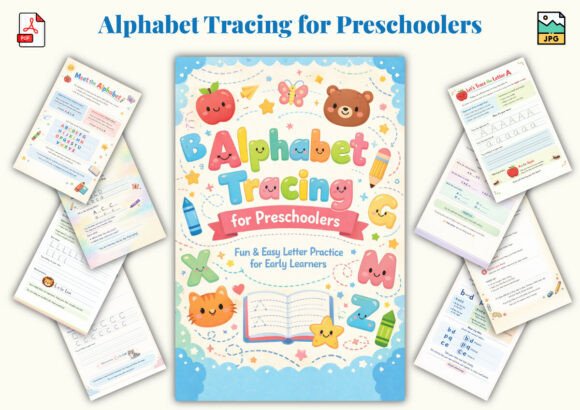
Step-by-step progression is one of the most important features. The workbook does not throw children into letter tracing without preparation. Instead, it begins with warm-up exercises that help children practice the fundamental strokes—straight lines, curves, loops, and zigzags—that make up all the letters of the alphabet. Only after building this foundation does the workbook introduce letter tracing, starting with letters A through O in a structured, incremental manner. This gradual approach ensures that children never feel overwhelmed.
Layout and Visual Appeal Matter More Than You Think
Young children are highly visual learners. They respond to clean, uncluttered pages that do not overstimulate their senses. The kid-friendly layouts in Alphabet Tracing for Preschoolers feature soft, playful colors and cute alphabet icons that draw a child's eye to the task without distracting from it. Each page feels inviting rather than intimidating. The consistent design also helps children quickly understand what is expected of them, promoting independent learning. When a child can look at a page and immediately know where to start and what to do, they are far more likely to engage with the material on their own.
Beyond the Letter: Recognition, Matching, and Play
Letter tracing is only one piece of the literacy puzzle. True alphabet mastery requires that children not only write letters but also recognize them, differentiate between uppercase and lowercase forms, and associate them with sounds and words. Alphabet Tracing for Preschoolers incorporates fun letter recognition activities, matching exercises, puzzles, and review pages that reinforce what children have learned through tracing. This multi-faceted approach ensures that the skills children build on one page transfer to the next, creating a cohesive learning experience.
Consider the matching activities: a child might trace the letter A and then match it to a picture of an apple. This simple act connects the abstract symbol (the letter A) to a concrete, familiar object. Over time, these connections build a mental map of the alphabet that goes far beyond rote memorization. The review pages, strategically placed throughout the workbook, give children the chance to revisit previously learned letters, strengthening their recall and building long-term retention.
Uppercase and Lowercase Practice in One Workbook
One common challenge for preschoolers is understanding that letters have two forms. A capital A and a lowercase a look quite different, yet they represent the same sound. Alphabet Tracing for Preschoolers addresses this by including both uppercase and lowercase practice for each letter. This dual exposure helps children become flexible readers and writers who can recognize letters in any context. It also saves parents and educators the trouble of finding separate resources for each case, making this workbook a comprehensive tool for early literacy development.
Practical Benefits for Parents and Educators
Choosing a workbook for a preschooler is not just about the child's experience; it is also about the adult's ability to facilitate learning effectively. Alphabet Tracing for Preschoolers is designed with busy parents and educators in mind. The instructions are simple and easy to follow, meaning you do not need a teaching degree to guide your child through the pages. The workbook is also available in both high-quality JPG and print-ready PDF formats, giving you flexibility in how you use the materials. Whether you prefer to print pages one at a time or work through a bound booklet, the format supports your preferred approach.
The 6 × 9 inch page size is another thoughtful detail. It is large enough for little hands to work comfortably but small enough to fit easily into a backpack or a learning binder. This portability means that learning does not have to be confined to a desk. A few pages can accompany you on a road trip, to a waiting room, or to a quiet corner of the living room on a rainy afternoon.
Supporting Independent Learning and Confidence
One of the most rewarding outcomes of using a well-designed tracing workbook is watching a child transition from needing help to working independently. The gradual progression built into Alphabet Tracing for Preschoolers naturally fosters this independence. As children master simpler tasks, they gain the confidence to tackle more challenging ones. Soon, they are tracing letters without prompting, pointing out letters they recognize in the world around them, and even attempting to write their own name. This independence is not just a convenience for parents; it is a crucial part of a child's social and emotional development. Learning to do something on their own builds self-esteem and a positive sense of identity as a learner.
Integrating Tracing into a Broader Preschool Routine
While a dedicated workbook is a powerful tool, it works best when integrated into a broader, balanced learning routine. Alphabet Tracing for Preschoolers is perfectly suited for this. A typical session might begin with a warm-up page of lines and shapes to get the hand moving, followed by a letter tracing page, and ending with a fun matching game or puzzle from the workbook. Total time investment can be as little as ten to fifteen minutes per day, which is ideal for the attention span of a preschooler.
Consider pairing the workbook with hands-on activities like finger painting letters, building them with play dough, or tracing them in a tray of sand. These multi-sensory experiences reinforce the same concepts in different ways, deepening a child's understanding. The workbook serves as the structured spine of your alphabet learning, while creative activities add variety and joy.
Who Benefits Most from This Workbook?
Alphabet Tracing for Preschoolers is designed for a wide range of learners. It is ideal for typically developing preschoolers who are ready to start writing, but it is also wonderfully suited for children who need extra support with fine motor skills or who benefit from a slower, more structured approach. Homeschool families will find it a valuable addition to their curriculum, as it covers foundational skills without requiring extensive prep time. Educators in preschool and kindergarten settings can use the pages for small group work, literacy centers, or take-home practice. Even parents who simply want to give their child a head start before formal schooling begins will find this workbook to be a reliable resource.
A Word on Durability and Reusability
One practical consideration for any workbook intended for young children is how well it holds up to repeated use. The print-ready PDF format of Alphabet Tracing for Preschoolers means you can print fresh copies as needed. This is especially useful if you have multiple children or if a child wants to practice a favorite page multiple times. For a more durable option, you can laminate the pages and use dry-erase markers, making the workbook reusable again and again. This flexibility is a significant advantage over traditional bound workbooks that can only be used once.
Building a Foundation for Lifelong Learning
The skills that children develop through alphabet tracing extend far beyond the preschool years. Fine motor control, hand-eye coordination, letter recognition, and the confidence to attempt new tasks are all assets that will serve children throughout their academic journey. By investing time in a quality tracing workbook, you are not just teaching your child to write the letter A; you are teaching them how to learn, how to persist through challenges, and how to take pride in their own progress. Alphabet Tracing for Preschoolers embodies this philosophy, offering a thoughtful, playful, and effective pathway into the world of letters and words.
For any parent or educator looking to support a preschooler's early writing development, this workbook represents a practical, engaging, and research-aligned choice. It meets children where they are, celebrates their small victories, and gently guides them toward the next milestone. And perhaps most importantly, it makes learning the alphabet feel like play—which is exactly how learning should feel at this age.