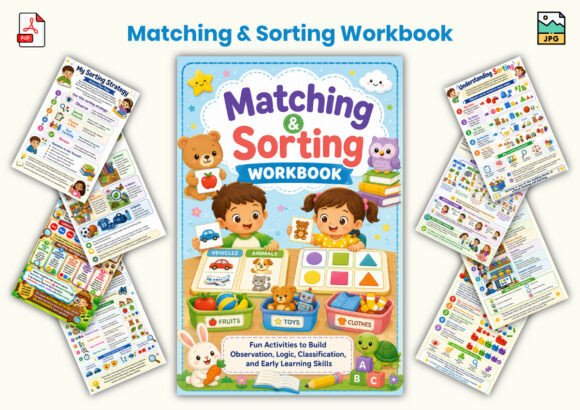
Matching Sorting Workbook for Early Learners
Building foundational skills in young children is one of the most rewarding challenges for parents, educators, and caregivers. The Matching Sorting Workbook offers a hands-on approach to developing observation, classification, and critical-thinking abilities in preschool, kindergarten, and early elementary learners. This resource transforms abstract concepts like matching, sorting, comparing, and pattern recognition into tangible activities that children can understand and enjoy.
At its core, this workbook provides 31 unique pages designed to guide young minds through structured learning experiences. Each page balances educational value with visual appeal, using child-friendly layouts that hold attention without overwhelming sensitive learners. The 6 × 9 inch format makes it portable for classrooms, home learning setups, or even quiet activities during travel.
What Makes This Workbook Different
Many early learning resources rely heavily on rote memorization or repetitive exercises that quickly lose a child's interest. The Matching Sorting Workbook takes a different path by combining explanation pages, infographic-style learning sections, tips and tricks, action-plan activities, and case-study examples within a single resource. This variety keeps children engaged while reinforcing key concepts through multiple angles of exposure.
The workbook covers essential topics including matching skills, sorting by color, shape, and size, pattern recognition, observation skills, classification concepts, comparison techniques, logical thinking, problem-solving strategies, organization skills, and real-life sorting examples. Rather than treating these as isolated subjects, it weaves them together in ways that show children how these skills connect in everyday situations.
Designed for Real Learning Environments
Whether you are a parent supplementing your child's education at home, a teacher looking for classroom-ready materials, or a homeschool educator building a curriculum from scratch, this workbook fits naturally into your routine. The print-ready design means you can use it immediately without complex preparation. The included high-quality PDF and JPG files give you flexibility to print individual pages as needed or work through the entire book sequentially.
The clean typography and balanced page layouts reduce visual clutter, helping children focus on the task at hand. Young learners with shorter attention spans benefit from pages that present manageable chunks of information without feeling sparse or uninteresting.
Building Essential Skills Through Matching and Sorting
Matching and sorting activities may seem simple, but they form the foundation for higher-order thinking. When a child matches identical objects, they practice attention to detail and memory recall. When they sort items by color, shape, or size, they learn to recognize attributes and make decisions based on observable characteristics. These are the same cognitive processes used in mathematics, science, reading, and everyday problem-solving.
The Matching Sorting Workbook introduces each concept gently, starting with basic matching tasks and gradually moving toward more complex sorting and classification exercises. This progression allows children to build confidence as they master each level before advancing. The pattern recognition activities, for example, challenge learners to identify sequences and predict what comes next—a skill that directly supports early math and reading development.
Practical Examples of Skills in Action
Consider a page focused on sorting by color. A child might be asked to group objects into red, blue, and yellow categories. This straightforward task teaches them to identify color as a defining attribute, compare items against each other, and organize information systematically. Later, a sorting-by-size activity might ask them to arrange objects from smallest to largest, introducing concepts of sequencing and relative measurement.
The real-life sorting examples included in the workbook show children how these skills apply beyond the page. Sorting laundry by color, organizing toys by type, or arranging books by size become meaningful extensions of the workbook activities. This connection between abstract exercises and tangible experiences reinforces learning in powerful ways.
Who Benefits from This Workbook
The primary audience for the Matching Sorting Workbook includes children aged three to seven, but the real beneficiaries are the adults guiding them. Parents appreciate having a structured resource that reduces planning time while delivering quality content. Teachers value the alignment with early learning standards and the ease of integrating pages into existing lesson plans. Homeschool educators find the comprehensive topic coverage helpful for building a well-rounded early education curriculum.
Beyond formal education settings, grandparents, babysitters, and caregivers can use this workbook as a reliable activity that combines fun with learning. The cute kindergarten educational theme appeals to children while maintaining a professional quality that adults find reassuring.
Supporting Different Learning Styles
Children learn in different ways, and this workbook accommodates varied preferences through its mixed approach. Visual learners benefit from the infographic-style pages and clear layouts. Kinesthetic learners gain from hands-on activities like drawing lines to connect matches or circling items that belong together. Logical learners thrive on the structured progression from simple to complex tasks. This versatility makes the workbook a valuable tool for reaching children who might struggle with single-method resources.
Using the Workbook Effectively
To get the most out of the Matching Sorting Workbook, consider establishing a consistent routine. Short, regular sessions often work better than longer, infrequent ones. Ten to fifteen minutes per day allows children to engage deeply without fatigue. Let the child's interest guide the pace—some pages may spark extended exploration while others move quickly.
Encourage conversation during activities. Ask questions like "Why did you put these together?" or "What is different about these two items?" These discussions deepen understanding and develop vocabulary around comparison and classification. The tips and tricks sections within the workbook offer additional guidance for facilitating these conversations naturally.
Adapting for Different Skill Levels
One advantage of this resource is its flexibility for varying ability levels. Younger or less experienced learners can focus on the basic matching and simple sorting pages. More advanced children can tackle the pattern recognition and problem-solving strategies sections. The action-plan activities and case-study examples provide opportunities for deeper engagement when a child is ready for additional challenge.
Parents and educators can also repeat pages after a gap of several weeks to reinforce retention and measure progress. What was difficult at first may become easy with practice, building a child's sense of accomplishment and motivation to continue.
Important Considerations Before Using
While the Matching Sorting Workbook is designed for independent use, adult guidance enhances the experience, especially for younger children. The explanation pages and infographic sections assume some ability to follow instructions, so sitting with a child during initial sessions helps establish proper understanding of each activity type.
The workbook's 6 × 9 inch size is convenient for travel but smaller than standard letter-size pages. Some children may prefer larger writing areas for certain exercises. In these cases, reproducing select pages at a larger scale using the included digital files can provide a comfortable alternative. The high-resolution JPG files make this adjustment simple without losing quality.
Consider the printing medium as well. Bright, colorful pages printed on quality paper enhance engagement, but even simple black-and-white prints preserve the educational value. Laminating select pages can create reusable activity sheets for repeated practice with dry-erase markers—a practical approach for classroom or frequent use.
Long-Term Value for Growing Learners
The skills developed through matching and sorting activities extend far beyond early childhood. Classification and comparison form the basis of scientific thinking. Pattern recognition supports mathematical reasoning and reading comprehension. Organization skills help with time management and task completion throughout life. By investing time in this workbook, adults provide children with cognitive tools that serve them across subjects and stages of development.
The Matching Sorting Workbook also introduces young learners to the structure of a workbook itself—following instructions, completing pages sequentially, reviewing past material, and building knowledge over time. These meta-skills prepare children for more formal educational experiences in elementary school and beyond.
A Resource That Grows with the Child
Unlike single-use activity books that are quickly outgrown, this workbook offers layers of value. Initial sessions might focus on simple matching under adult supervision. Later, children can independently tackle sorting and classification tasks. The summary and review pages provide opportunities to revisit earlier concepts with fresh perspective, reinforcing long-term retention.
The included case-study examples present scenarios that invite discussion and extended thinking. A page about sorting items in a grocery store, for instance, can lead to conversations about food groups, healthy choices, and even basic economics—all from a simple sorting activity. This depth makes the workbook relevant for months rather than days.
Bringing Learning into Everyday Life
The ultimate goal of any early learning resource is to transfer skills from the page into the world. The Matching Sorting Workbook supports this transfer explicitly through its real-life sorting examples and implicitly through its emphasis on observation and classification. A child who practices sorting by size in the workbook may naturally begin organizing their toys by size at home. A child who learns pattern recognition may start noticing patterns in clothing, nature, or music.
Encouraging these real-world applications strengthens the connection between workbook activities and daily experience. Simple comments like "I noticed you sorted your crayons by color—just like in your workbook" validate the child's efforts and reinforce the relevance of their developing skills.
For educators and parents seeking a practical, engaging, and thoughtfully designed resource for early cognitive development, the Matching Sorting Workbook offers a complete package. Its balanced approach to content, design, and usability makes it a reliable addition to any early learning environment, supporting children as they build the foundational skills that will serve them for years to come.