2026–2027 Burnout Recovery Planner: A Strategic Tool for Rebuilding Balance and Intentional Living
If you have spent the past few years running on empty—juggling deadlines, client demands, creative projects, or the quiet weight of constant responsibility—you already know that pushing harder is not a long-term strategy. The question is not whether you need to slow down, but how to do it without losing momentum or dropping everything that matters. The 2026–2027 Burnout Recovery Planner offers a structured yet flexible path for exactly this challenge. It is not a productivity hack or a quick fix. It is a two-year workbook designed to help you reset, rebuild balance, and make decisions that support both your well-being and your work.
Many professionals, entrepreneurs, and creators reach a point where their usual systems stop working. To-do lists feel overwhelming, motivation fades, and even small tasks require disproportionate energy. That is the moment when a recovery-oriented planner becomes more than a scheduling tool—it becomes a decision-making framework. The 2026–2027 Burnout Recovery Planner provides that framework by blending structured planning with mental health worksheets, goal-setting pages, mindfulness exercises, and self-reflection prompts. It is built for people who need to recover without abandoning their ambitions.
What Makes the 2026–2027 Burnout Recovery Planner Different
Standard planners focus on productivity: what to do, when to do it, and how to fit more into each day. That approach works well when you are already operating from a place of balance. But if you are recovering from burnout, adding more structure to an already overloaded life can backfire. The 2026–2027 Burnout Recovery Planner takes a different approach. It asks you to slow down first, then rebuild. It includes goal-setting and productivity pages, but those sections are paired with self-care habit trackers, wellness tracking, and emotional awareness exercises. The planner does not assume you are starting from full capacity. It assumes you are rebuilding.
The undated two-year layout covering 2026 and 2027 gives you room to move at your own pace. You are not locked into a rigid timeline. If a week needs to be lighter, you can adjust. If a month requires deeper reflection, the journaling and self-reflection sections are there to support that. This flexibility is important because burnout recovery is not linear. Some weeks will feel productive. Others will feel slow. The planner accommodates both without judgment.
How Thoughtful Use Supports Long-Term Goals and Daily Decisions
One of the most strategic uses of the 2026–2027 Burnout Recovery Planner is as a tool for redefining what success looks like. Many professionals measure themselves by output: emails sent, projects completed, revenue generated. But after burnout, those metrics often lose meaning or become sources of stress. The planner encourages you to set goals that are aligned with recovery, not just achievement. For example, instead of setting a goal to increase client volume by 20 percent, you might set a goal to improve your energy consistency over six months. That shift changes how you allocate time, how you evaluate progress, and how you make decisions about new opportunities.
For freelancers, marketers, and small business owners, this distinction matters. Your ability to produce high-quality work depends on your mental and emotional state. A planner that tracks wellness alongside deadlines helps you spot patterns before they become crises. You might notice that your creativity drops in weeks when you skip rest, or that your decision-making improves when you maintain a consistent morning routine. The data you collect in the wellness tracking pages becomes a feedback loop—not for guilt, but for smarter planning.
The planner also supports goal setting in a way that respects your current limits. Rather than pushing you to set ambitious stretch goals, it encourages you to identify what is realistic and sustainable. This is particularly useful for decision-makers who are responsible not only for their own output but for teams or businesses. If you are a manager or founder, your recovery has ripple effects. Using a recovery-focused planner can help you model healthier rhythms for your team, communicate boundaries more clearly, and avoid the costly cycle of overwork followed by shutdown.
Practical Use Cases for Different Professional Contexts
The value of the 2026–2027 Burnout Recovery Planner becomes clearer when you consider specific scenarios. Imagine a content creator who has been publishing weekly for years and is now experiencing creative fatigue. The planner’s mindfulness and relaxation exercises can be used as pre-writing rituals. The goal-setting pages can help restructure content calendars around lower volume but higher quality. The journaling prompts can surface underlying frustrations about the work itself, leading to honest decisions about whether to pivot or repurpose.
Consider an educator or academic who faces constant emotional demands. The self-care habit trackers and emotional awareness worksheets offer a framework for checking in before and after demanding interactions. Over time, that practice builds resilience. It also creates a record of what drains energy and what restores it—information that is invaluable when planning course loads, office hours, or research time.
For a small business owner, the planner can function as a strategic review tool. The vision and personal growth pages are especially relevant here. Business owners often neglect their own development in favor of operational tasks. The planner forces a pause by design. It asks questions about what you want your life to look like, not just your business. Those answers inform decisions about hiring, pricing, and scope of services. When you are clear about your personal priorities, you are less likely to take on clients or projects that undermine your recovery.
When to Use the Planner and How to Approach It
Timing matters. The 2026–2027 Burnout Recovery Planner is most effective when you are ready to acknowledge that your current pace is unsustainable. That may be right after a major project ends, during a slower season, or at the start of a new year. The undated format means you do not have to wait for January. You can begin at any point that feels right.
A helpful approach is to start with the self-reflection and emotional awareness sections before diving into goal-setting. Many people rush to set new goals as a way to feel in control, but recovery requires understanding where you are first. Spend a week or two using the journaling prompts and wellness tracking without trying to change anything. Observe your patterns. Notice when you feel most drained and when you feel most alive. That information will make your goal-setting more grounded.
After that initial observation period, move into the goal-setting and productivity pages. Choose one or two priorities that directly support your recovery, such as establishing a consistent sleep schedule or reducing work hours on certain days. Use the self-care habit trackers to reinforce those priorities. The planner is designed to be used sequentially, but you can also jump between sections as needed. If a particular week feels stressful, the relaxation exercises are there. If you need clarity on a decision, the vision pages can help.
Risks of Using the Planner Without Clear Intentions
Like any tool, the 2026–2027 Burnout Recovery Planner can be misused. The most common risk is treating it as another productivity system. If you fill in every tracker, complete every worksheet, and pressure yourself to use every page perfectly, you are recreating the same patterns that led to burnout. The planner is not a test. It is a guide. Its value comes from thoughtful use, not from completion.
Another risk is using the planner in isolation. Recovery often requires changes in environment, relationships, and boundaries. No workbook can replace honest conversations with a supervisor, partner, or therapist. The planner can help you clarify what those conversations need to address, but it cannot have them for you. If you find yourself avoiding difficult decisions while diligently filling out pages, the planner may be functioning as a distraction rather than a recovery tool.
There is also the risk of misinterpreting the goal-setting sections. Because the planner includes productivity pages, you might be tempted to set goals that look impressive but are not aligned with your current capacity. Be honest with yourself. A goal to launch a new service line may need to wait. A goal to take a real lunch break five days a week is valid and impactful. The planner works best when you let it challenge your assumptions about what counts as progress.
Using the Planner Intentionally Rather Than Randomly
Intentional use starts with defining your primary reason for picking up the planner. Are you trying to recover from a specific period of exhaustion? Are you building long-term habits to prevent future burnout? Are you reevaluating your career or business direction? Your answer will determine which sections you prioritize and how often you revisit them.
Consider keeping a brief note at the beginning of the planner stating your intention. That note can serve as an anchor when you feel uncertain about how to use the tool. For example, you might write: “I am using this planner to rebuild a sustainable rhythm for my consulting practice and to restore my energy for creative work.” That statement will help you decide whether a particular exercise is useful or irrelevant to your situation.
Another strategy is to schedule a weekly review of your planner entries. This does not mean redoing everything. It means spending ten minutes looking at what you tracked, what you wrote, and what patterns are emerging. That review turns the planner from a static document into a living strategy. You will start to notice which habits support your recovery and which ones drain you. You will see when your energy dips and when it peaks. That awareness makes your planning more accurate and your decisions more aligned with your actual needs.
Long-Term Value and Sustainable Results
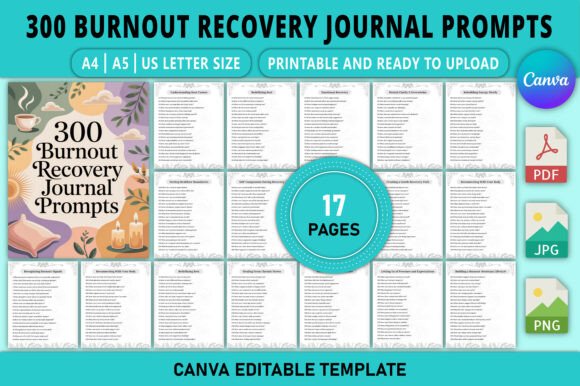
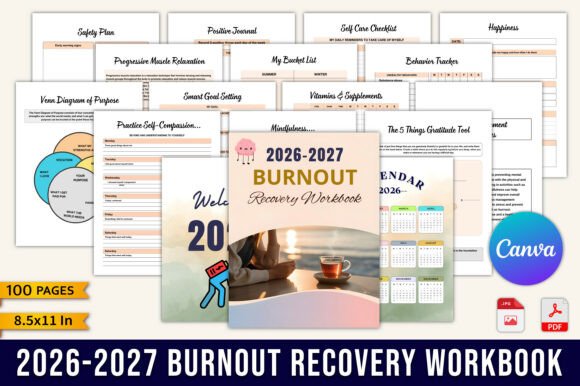
The 2026–2027 Burnout Recovery Planner covers two years and includes 100 different Canva templates, which means you have room to evolve. What feels relevant in the first month may shift after six months. The planner accommodates that change because it is not locked into a single method. You can revisit sections, skip others, and adapt as your recovery progresses.
Over time, the planner can shift from a recovery tool to a prevention tool. Once you have rebuilt a baseline of balance, the wellness tracking and self-reflection pages become early warning systems. You will notice small signs of imbalance before they escalate. That is the long-term value: not just recovering from burnout, but learning how to stay out of it.
For professionals, creators, and decision-makers, that skill is invaluable. Your work depends on your ability to think clearly, make sound judgments, and sustain effort over time. A planner that supports your recovery is also supporting your performance, your creativity, and your relationships. The 2026–2027 Burnout Recovery Planner is not about doing less forever. It is about doing the right things in a way that keeps you whole. That is the foundation for any meaningful long-term result.
Final Considerations Before You Begin
If you choose to use this planner, approach it with the same care you would give a trusted colleague. Be patient with yourself. Skip pages that do not resonate. Write messily if that feels more honest. The editable Canva link and high-quality PDF files give you flexibility in how you use the materials—print them, edit them digitally, or combine both. The page size is 8.5×11 inches, standard and easy to bind or store.
The 2026–2027 Burnout Recovery Planner is a thoughtful resource for anyone who is ready to rebuild from a place of awareness rather than obligation. It does not promise instant transformation, but it provides a reliable structure for gradual, meaningful change. If you are tired of strategies that demand more from you, this planner offers something different: a way to move forward without leaving yourself behind.