2026–2027 Small Business Planner: Build a Strategic Foundation for Growth
Running a small business means juggling dozens of moving parts — from product development and inventory to customer outreach and financial tracking. Without a system, even the most promising ideas can get lost in the noise. The 2026–2027 Small Business Planner offers a structured yet flexible framework to help you manage daily operations while keeping your long-term vision in focus. It’s not just a calendar with extra pages; it’s a coordinated set of tools designed to support planning, decision-making, and consistent execution over two years.
Why a Two-Year Planning Horizon Matters for Small Businesses
Many entrepreneurs operate in reactive mode — responding to immediate demands rather than shaping their trajectory. A planner that spans 2026 and 2027 encourages you to think beyond the next quarter. When you map out goals, budgets, and projects across a longer period, you gain perspective on seasonal patterns, cash flow cycles, and strategic milestones. The 2026–2027 Small Business Planner includes calendars for both years, allowing you to see how your initiatives evolve and where adjustments may be needed before deadlines catch up with you.
For a startup, a two-year view helps you validate whether your product roadmap aligns with market realities. For an established business, it supports scenario planning — what happens if a key supplier changes terms, or if a new competitor enters your niche? By laying out your assumptions now, you can test them against actual results and course-correct with confidence.
Core Components That Support Strategic Execution
This planner is divided into sections that reflect the main dimensions of running a business: planning, operations, finance, and reflection. Each section serves a specific purpose, but they are designed to work together.
Business Foundation and Market Positioning
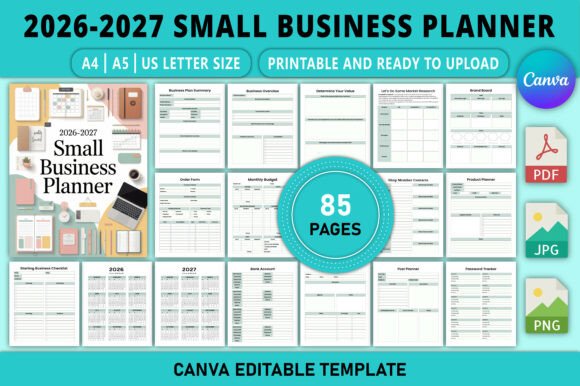
The Business Plan Summary and Starting Business Checklist push you to clarify what you’re building and why. Before investing time in daily planning, it pays to define your mission, value proposition, and market position. The Market Research section asks you to examine customer needs and competitive dynamics — a step many founders skip until they hit a revenue plateau. By documenting these insights, you create a reference point for future decisions.
The Brand Board is more than a mood board. It forces you to articulate visual and tonal consistency across channels. When you later design marketing materials or update your website, that board saves hours of guesswork. It also helps you communicate your identity to freelancers or employees who need to represent your business accurately.
Product Planning and Operations
For product-based businesses, the Product Ideas and Product Inventory pages provide a structured way to evaluate new offerings. You can rank ideas by feasibility, cost, and market demand before committing resources. The Order Form and Order Tracker keep client transactions organized, reducing the risk of missed deliveries or billing errors. Combined with the Inventory Log, these tools give you a real-time picture of what’s selling and what’s sitting idle.
Service-based entrepreneurs will find the Projects and Invoice sections equally valuable. Tracking each engagement from proposal to payment ensures nothing falls through the cracks. Over time, reviewing your order history reveals patterns — which services are most profitable, which clients require disproportionate support, and where you might raise prices.
Financial Planning and Accountability
Budgeting is where many small businesses stumble. The Monthly Budget and Budget Spreadsheet let you forecast income and expenses, then compare projections with actuals. This habit transforms budgeting from a yearly exercise into an ongoing management tool. When you see a category running over budget in March, you can adjust spending before it becomes a crisis.
The Bank Account and Shop Member Contacts pages support record-keeping that accountants and investors appreciate. While these may seem administrative, they reduce the friction of tax season and help you maintain professional relationships with vendors and collaborators.
Using the Planner Intentionally — Not Just Filling Pages
A planner’s effectiveness depends on how you use it. Simply copying your to-do list from sticky notes to a printed page doesn’t create strategy. The 2026–2027 Small Business Planner becomes powerful when you approach it with intention.
Start with the Annual Overview, Then Work Backward
Begin by setting three to five major outcomes for each year. Then use the Monthly Planner to break those outcomes into quarterly and monthly milestones. For example, if your 2026 goal is to launch a second product line, identify the steps — market research, prototyping, testing, production — and assign each to a specific month. The Weekly Planner and Daily Planner then become the execution layer where you schedule the actual work.
Use the Daily Reflection to Learn from Experience
The Daily Reflection section is often overlooked, but it’s one of the most valuable tools for long-term improvement. Spend five minutes each evening noting what worked, what didn’t, and what you’ll try tomorrow. Over weeks, these entries reveal behavioral patterns — perhaps you consistently underestimate how long client calls take, or you’re most productive on Tuesday mornings. Adjust your schedule accordingly rather than fighting your natural rhythms.
Review Monthly Set Tasks Against Progress
The Monthly Set Tasks page helps you distinguish between recurring obligations and growth initiatives. If you notice you’re spending all your time on maintenance activities — invoicing, restocking, responding to emails — you can intentionally reserve blocks for strategic work like market research or product development. Without this separation, urgent tasks always crowd out important ones.
For a Solo Freelancer or Creator
You might use the Invoice and Order Tracker to manage client projects, the Monthly Budget to track irregular income, and the Daily Planner to structure your work around client deadlines. The Brand Board ensures your social media and portfolio maintain a consistent look even when you’re juggling multiple projects.
For a Small Retail or E-commerce Operation
The Product Inventory and Inventory Log become your operational backbone. Use the Order Form to standardize how you capture customer requests, and the Order Tracker to monitor fulfillment times. The Bank Account page helps you separate personal and business finances — a critical step for tax compliance and profitability analysis.
For a Team Leader or Department Manager
While the planner is designed for individual use, you can adapt the Projects and Shop Member Contacts sections to coordinate with a small team. Share the Annual Overview during planning meetings to align everyone on priorities. The To-Do Business section can track delegated tasks and deadlines, reducing the need for constant check-ins.
Risks of Using a Planner Without Clear Goals
Like any tool, this planner can become busywork if you lack a strategic context. Filling out every page without connecting it to your actual business objectives creates a false sense of progress. You might spend hours organizing your inventory log but never analyze which products generate the most profit. You might track every expense in the budget spreadsheet but never review whether your spending aligns with your growth priorities.
Another risk is over-planning at the expense of action. The 2026–2027 Small Business Planner includes many prompts, and it’s tempting to complete them all before starting any real work. Instead, pick the sections most relevant to your current stage. If you’re launching a business, prioritize the Business Plan Summary, Market Research, and Product Ideas. If you’re scaling, focus on Monthly Budget, Order Tracker, and Projects. You can always add sections later as your needs evolve.
Finally, don’t treat the planner as a fixed contract. Markets shift, customer preferences change, and unexpected opportunities arise. Use the Daily Reflection and Monthly Overview to assess whether your plans still make sense. A planner should guide you, not lock you into a path that no longer serves your business.
Making the Planner Work for Your Unique Context
The 2026–2027 Small Business Planner comes as a digital printable with an editable Canva template, so you can adjust fonts, colors, and layout to match your brand. More importantly, you can modify the categories themselves. If you run a service business, rename “Product Inventory” to “Service Offerings” and “Order Form” to “Proposal Template.” If you teach or coach, adapt the Projects section to track curriculum development or client sessions.
The real value lies not in the printed pages but in the discipline they encourage. When you regularly review your Annual Overview, you keep your long-term goals visible. When you update your Budget Spreadsheet each month, you build financial awareness. When you reflect daily, you cultivate a learning mindset that improves every aspect of your business.
Final Considerations Before You Begin
Before you commit to using this planner through 2026 and 2027, ask yourself a few questions:
- What are the three most important outcomes I want to achieve by the end of 2026? If you can’t name them, start there before filling any pages.
- Which areas of my business are most chaotic right now? Target those sections first — whether it’s tracking orders, managing cash flow, or clarifying your brand.
- How much time can I realistically dedicate to planning each week? Consistent ten-minute reviews are more effective than marathon sessions once a month.
- What data or insights do I currently lack? The planner can help you gather that information, but only if you decide what matters.
Approach the 2026–2027 Small Business Planner as a living system — one that adapts as your business grows. Use it to capture what you learn, test your assumptions, and make better decisions. With thoughtful use, it becomes more than an organizer; it becomes a strategic partner in building something that lasts.