2026 Financial Budget Planner: Your Complete Guide to Smarter Money Management
If you have ever felt that your finances run you rather than the other way around, you are not alone. Many people start the year with good intentions—tracking expenses here, setting a savings goal there—only to lose momentum by February. The challenge is rarely a lack of motivation. More often, it is the absence of a single, organized system that ties everything together. That is exactly where the 2026 Financial Budget Planner steps in. Designed to bridge the gap between intention and action, this planner offers a complete framework for anyone ready to take full control of their money in the coming year.
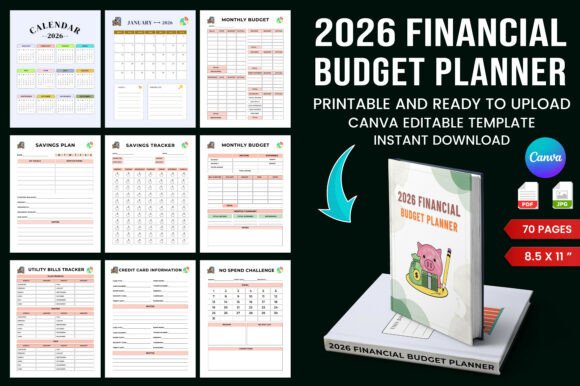
Rather than offering a generic calendar with a few budget lines, this planner brings together over thirty dedicated tools that cover daily spending, monthly budgeting, savings challenges, debt repayment, and long-term financial goals. Whether you are managing a household budget, running a small business, or simply trying to build better habits around money, the 2026 Financial Budget Planner gives you a single place to track, plan, and optimize every dollar.
Why a Dedicated Budget Planner Matters More Than Ever in 2026
The financial landscape continues to shift. Inflation pressures, variable income streams, and the growing complexity of subscriptions, utility bills, and online spending mean that a simple spreadsheet or mental budget often falls short. A dedicated planner like the 2026 Financial Budget Planner provides structure, accountability, and visibility. It transforms abstract numbers into a living document that you interact with daily, weekly, and monthly.
One of the standout advantages of using a purpose-built planner is the reduction of cognitive load. Instead of juggling multiple apps, sticky notes, and bank statements, you have one authoritative source of truth. This not only reduces stress but also helps you catch small issues—like a forgotten subscription or an overspend in a single category—before they become larger problems.
Comprehensive Features That Cover Every Aspect of Your Finances
The 2026 Financial Budget Planner is built around a simple philosophy: your financial life is interconnected, and your planning tool should reflect that. Below is an overview of the major feature categories and how they work together to give you a complete picture.
Calendar and Overview Tools for Big-Picture Planning
- Full 2026 Calendar Overview – See the entire year at a glance, mark key financial dates, and plan ahead for irregular expenses.
- Yearly Overview and Yearly Income pages – Track your total expected income and compare it against projected annual spending.
- Annual Finance and Yearly Financial Overview – Summarize your year-end position and use the data to inform the next year’s planning.
These tools are especially valuable for professionals and business owners who need to forecast cash flow and plan for tax obligations or major purchases. By starting with the big picture, you can then drill down into the details with confidence.
Daily, Weekly, and Monthly Tracking Tools
This is where the rubber meets the road. The planner includes multiple budgeting formats so you can choose the one that fits your income rhythm:
- Weekly Budget and Bi-Weekly Budget – Perfect for those paid weekly or every two weeks. Track expenses in real time and adjust before the period ends.
- Paycheck Budget – Assign every dollar from each paycheck to a specific category. Ideal for variable or freelance income.
- Monthly Budget and Budget Planner – Classic monthly layouts with room for detailed category breakdowns.
- Budget Tracker and Expense Tracker – Record actual spending against your planned amounts and identify patterns over time.
- Spending Tracker – A focused log for discretionary spending, helping you see where small leaks add up.
For example, a freelance graphic designer with irregular monthly income might rely heavily on the Paycheck Budget and Bi-Weekly Budget pages, while a salaried employee with fixed expenses may find the Monthly Budget and Expense Tracker more than sufficient. The beauty of the 2026 Financial Budget Planner is that you are not locked into one approach—you can mix and match based on the season of your financial life.
Savings, Goals, and Future Planning
Saving money consistently is one of the hardest financial skills to master. This planner includes several tools designed to make saving automatic and visible:
- Savings Plan and Savings Tracker – Set a target amount and track progress week by week or month by month.
- No Spend Challenge – A fun, structured way to reset your spending habits for a set period.
- 10 Savings Challenges – Ten different challenge formats to keep you motivated throughout the year.
- Financial Goal and Future Goals – Define short-term and long-term goals (e.g., emergency fund, down payment, vacation).
- Vacation Budget – Plan travel expenses without blowing your overall budget.
- Retirement Tracker and Retirement Savings – Monitor contributions and growth toward retirement targets.
- Sinking Funds – Set aside money for predictable but irregular expenses like car repairs or annual insurance premiums.
One real-world scenario: A young professional aiming to save for a home down payment could use the Savings Plan, Sinking Funds, and Financial Goal pages together. The No Spend Challenge could be used quarterly to accelerate savings, while the Retirement Tracker ensures long-term goals are not neglected in the pursuit of short-term wins.
Debt Management and Credit Tracking
Debt can feel overwhelming, but the 2026 Financial Budget Planner provides structured tools to tackle it systematically:
- Debt Snowball Tracker – List debts from smallest to largest and track payments using the snowball method.
- Credit Card Information – Keep key details, interest rates, and due dates in one place.
- Net Worth – Calculate assets minus liabilities to see your true financial position.
For someone carrying multiple credit card balances, the Debt Snowball Tracker paired with the Monthly Budget can create a clear path to becoming debt-free. Seeing the snowball grow—as each small debt is eliminated—provides powerful motivation to keep going.
Bills, Subscriptions, and Quarterly Obligations
Forgotten bills and unused subscriptions are silent budget killers. This planner includes dedicated pages to keep them in check:
- Bills Subscriptions and Monthly Bill Tracker – Log every recurring payment with amounts and due dates.
- Utility Bills Tracker and Quarterly Bills Tracker – Separate spaces for utilities and less frequent quarterly bills.
- Insurance Tracker – Monitor policies, premiums, and renewal dates.
- Online Shopping Tracker – A specific log for e-commerce purchases, which are easy to overlook.
Imagine a family managing multiple streaming services, gym memberships, insurance policies, and quarterly tax payments. Without a dedicated system, it is nearly impossible to track everything. The 2026 Financial Budget Planner makes it simple to review all subscriptions in one place and cancel those no longer needed.
Tax, Donations, and Specialized Tracking
For those who itemize deductions or give regularly to charity, the planner includes:
- Tax Deduction log – Track deductible expenses throughout the year, saving you stress at tax time.
- Donation Tracker – Record charitable contributions for personal records and tax purposes.
- Checkbook Register – A classic tool for those who still write checks or want a manual ledger of transactions.
- Upcoming Expenses – A forward-looking page to anticipate and prepare for known costs.
For a small business owner or freelancer, the Tax Deduction and Donation Tracker pages can save hundreds of dollars by ensuring every eligible deduction is captured. Paired with the Yearly Income and Expense Tracker, these tools create a complete financial record that simplifies tax filing significantly.
Who Will Benefit Most from This Planner?
The 2026 Financial Budget Planner is versatile enough to serve a wide range of users, but certain groups will find it especially valuable:
- Individuals and households – Anyone looking to reduce financial stress, pay off debt, or save for a specific goal will find the structure they need.
- Freelancers and gig workers – Variable income demands flexible budgeting tools. The Paycheck Budget and Bi-Weekly Budget pages are ideal for this group.
- Small business owners – Separating business and personal finances is critical. The planner’s expense tracking, tax deduction log, and checkbook register support this separation.
- Retirement planners – The Retirement Tracker, Net Worth, and Sinking Funds pages help those focused on long-term wealth building.
- Couples and families – Shared financial goals are easier to manage when both partners can see the same numbers in the same place.
One practical tip: If you are new to detailed budgeting, start with just two or three pages—Monthly Budget, Expense Tracker, and one Savings Challenge. As you build confidence, add more tools like the Debt Snowball Tracker or Vacation Budget. The 2026 Financial Budget Planner is designed to grow with you, not overwhelm you on day one.
Strengths and Practical Considerations
Every tool has its strengths and limitations. Here is an honest look at what you can expect from this planner:
Strengths
- All-in-one design – No need to juggle multiple notebooks or apps. Everything is bound together in a logical sequence.
- Variety of budgeting formats – Because one size does not fit all, the range of weekly, bi-weekly, paycheck, and monthly options is a genuine strength.
- Goal-oriented structure – The inclusion of savings challenges, debt trackers, and future goals keeps the focus on progress, not just tracking.
- Tax and donation tracking – A feature often missing from general planners, yet highly useful for maximizing deductions.
Considerations
- Initial setup time – With over thirty sections, setting up the planner for the first time may take an hour or two. This is time well spent, but worth noting.
- Paper vs. digital preference – This is a physical planner. If you prefer digital tools, consider whether you are ready to commit to a paper-based system.
- Not all pages may be relevant – Depending on your situation, some sections (e.g., Insurance Tracker or Online Shopping Tracker) may see little use. That is fine—use what serves you.
How to Evaluate Whether This Planner Is Right for You
Before committing to any financial planning system, ask yourself a few questions:
- Do I currently have a single place where I track all my income, expenses, debts, and goals?
- Have I missed a bill or subscription payment in the last six months?
- Do I want to save for a specific goal but lack a structured way to track progress?
- Am I comfortable using a physical planner for at least part of my financial management?
If you answered yes to any of these, the 2026 Financial Budget Planner likely offers the structure and features you need. It is particularly well-suited for those who appreciate the tactile experience of writing things down and find that the act of recording transactions helps reinforce mindful spending.
Final Thoughts: A Planner That Meets You Where You Are
The 2026 Financial Budget Planner is not a magic solution—it is a tool. Like any tool, its value depends on how consistently you use it. But the thoughtful design, comprehensive feature set, and focus on real-world financial challenges make it one of the most practical resources available for taking control of your money in 2026. Whether you are just starting your financial journey or looking to refine an existing system, this planner provides the structure, flexibility, and motivation to help you succeed.