Log Books – A Practical All-in-One System for Business, Health, and Password Management
In a world where digital tools multiply faster than we can track them, sometimes the most effective solution is also the simplest. Log Books, a 30-page digital log book designed for tracking business activity, health routines, and passwords in one clean document, offers an interesting middle ground between full-featured apps and paper notebooks. It is not trying to replace your project management software or fitness tracker. Instead, it provides a structured, printable, or digitally fillable space to record what matters most across three core areas of daily life. For anyone juggling multiple responsibilities, this kind of consolidated approach can reduce the mental overhead of remembering which system holds which piece of information.
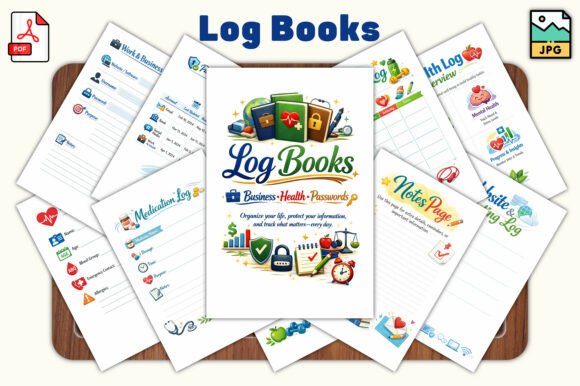
The product is straightforward by design. A single file in JPG and PDF formats, formatted at 6 × 9 inches, with a minimal white background. No fluff, no branding, no distracting graphics. The pages are divided into three distinct sections: business, health, and passwords. Each section contains dedicated pages for the most common tracking needs within those domains. The question is whether a simple log book format can genuinely serve the organizational needs of busy professionals, entrepreneurs, and creators. After examining the structure, the layout, and the real-world scenarios where it would be used, the answer depends largely on how you prefer to work and what you are trying to accomplish.
The Structure That Makes Multi-Domain Tracking Feasible
The first thing worth noting about Log Books is how it avoids the common pitfall of being too broad to be useful. Rather than trying to include every possible category, it focuses on three sections that are directly relevant to anyone running a business, managing personal health, or safeguarding digital access. Each section has clearly defined pages with labeled fields, which means you do not waste time deciding what to write where. The business section includes daily activity logs, income and expense entries, client and customer records, monthly summaries, and productivity tracking. The health section covers daily health and mood tracking, exercise and fitness logs, meal and nutrition records, medication tracking, and sleep and wellness monitoring. The password section provides space for email accounts, social media logins, banking and financial records, work and website login pages, and password update tracking.
This structure matters because it reduces friction. When you open the log book, you know exactly which page to turn to. The consistency across sections also helps build a habit. If you use the business log every day, it becomes natural to flip to the health log afterward. The password log, while used less frequently, is always available when you need to record a new credential or update an old one. The 30-page count is worth noting. It is not a year-long journal. It is more like a monthly reset or a focused sprint. This makes it particularly suitable for people who prefer short-term tracking cycles or who want to test the system before committing to a larger format.
Strengths in Real-World Use: Where Log Books Shines
In practice, the biggest advantage of this log book is its portability and flexibility. The 6 × 9 inch size is large enough to write in comfortably but small enough to fit in a bag or sit on a desk without taking over your workspace. Because it is delivered as both JPG and PDF, you have options. You can print the pages and use them as a physical booklet, or you can fill them digitally using a PDF editor or annotation app. This dual-format approach respects different workflows. Someone who prefers handwriting can print and bind. Someone who works primarily on a tablet can import the PDF into GoodNotes, Notability, or similar apps and write with a stylus. The same applies to the JPG files for use in other creative or organizational tools.
The clean, minimal white design is another practical strength. There are no colored backgrounds, heavy graphics, or decorative elements that consume ink or distract the eye. The layout prioritizes function. Fields are clearly labeled, spacing is generous enough for handwritten entries, and the overall aesthetic is neutral enough to feel professional in a business context. This matters because a log book that looks cluttered or overly styled can discourage consistent use. Log Books avoids that entirely. It looks like a tool, not a decoration.
For entrepreneurs and small business owners, the business log section covers the essentials. You can record daily income and expenses, which is useful for cash flow awareness between accounting cycles. The client and customer records page helps track who you are working with and what was discussed. The monthly summary page offers a macro view that can inform whether your productivity and revenue are trending in the right direction. While it will not replace a dedicated accounting system, it serves as a real-time snapshot that keeps you grounded in the numbers that matter day to day.
The health log section follows the same philosophy. It is not a medical record. It is a daily check-in. Tracking mood, exercise, meals, medication, and sleep in one place can reveal patterns that would otherwise go unnoticed. For example, you might notice that low-energy days often follow poor sleep, or that your mood is consistently better on days you log a workout. This kind of personal data, collected consistently, becomes a practical tool for self-management. The medication tracking page is particularly useful for anyone managing prescriptions or supplements across multiple times of day.
The password log section addresses a universal pain point. While password managers are widely recommended, not everyone uses them comfortably. Some people prefer a physical or locally stored digital record that they control completely. Log Books provides a structured way to do that. The pages are designed for account names, URLs, usernames, passwords, and update dates. If you keep the file locally on an encrypted device or store the printed version in a secure location, this can be a reliable fallback or primary system for credential management. The password update tracking page adds accountability, helping you rotate credentials on a regular schedule.
Who Benefits Most and in Which Situations
Log Books is best suited for individuals who value structure but do not want to invest time learning complex software. Freelancers, bloggers, solo entrepreneurs, students, and serious hobbyists will find the format immediately usable. It also works well for professionals who operate across multiple domains, such as a consultant who manages client work, personal health goals, and digital security all in one day. The multi-purpose design eliminates the need to carry separate notebooks or maintain multiple digital documents.
Coaches and educators could also use this log book as a teaching tool or client resource. A health coach might share the health log section with clients for habit tracking. A business mentor might recommend the business log to new entrepreneurs who need a simple way to track revenue and expenses before they are ready for accounting software. The neutral design makes it easy to repurpose.
That said, Log Books is not designed for deep analysis. If you need advanced reporting, visual dashboards, or team collaboration, this format will not provide it. It is a recording tool, not an analytical engine. You get out of it what you put into it. The quality of your tracking depends on your consistency. For some users, the lack of automated reminders or integrations may be a limitation. But for those who prefer manual tracking and the clarity that comes with writing things down, this is not a weakness. It is a feature.
Quality, Durability, and Long-Term Value
Since Log Books is a digital product, quality is determined by the design and formatting. The files are cleanly laid out, with proper alignment and readable fonts. The PDF is print-ready with standard margins, and the JPG format works across image-compatible platforms. The 30-page count is intentional. It keeps the file lightweight and encourages regular use without feeling overwhelming. For long-term value, you can reprint or reuse the file as many times as needed. A single purchase effectively gives you unlimited copies for personal use. This makes it a cost-effective organizational tool compared to subscription-based apps or pre-printed notebooks that run out.
One practical recommendation is to print the pages on good-quality paper if you plan to write by hand. A heavier weight paper, around 24 lb or more, will prevent ink bleed and hold up to daily handling. If you use it digitally, make sure your annotation app supports PDF forms or freeform writing. Most modern apps handle the format well. Another consideration is binding. If you print all 30 pages, consider whether you want them loose, stapled, hole-punched in a binder, or spiral-bound at a print shop. The format is flexible enough to accommodate any of these approaches.
Limitations Worth Noting
No tool is perfect for everyone, and Log Books has a few clear limitations. The 30-page count means you will cycle through it relatively quickly if you use it daily. For some users, this is a benefit, as it provides a natural review period. For others, it may feel like too much reprinting. The password section, while useful, should be used with caution. If you store digital copies, ensure they are kept in a secure, encrypted location. If you print the pages, store them in a locked drawer or safe. The log book itself cannot enforce security, so that responsibility falls entirely on the user.
Additionally, the health log section is not a substitute for professional medical advice or clinical tracking. It is a personal record, not a diagnostic tool. Users with complex health conditions may need more specialized tracking sheets. The same applies to business tracking. Freelancers with high transaction volumes may outgrow the income and expense pages quickly. In those cases, Log Books works best as a supplement to more robust systems, not a replacement.
Final Thoughts on Practical Fit
Log Books occupies a specific and useful niche. It is a low-friction, multi-domain tracking tool that prioritizes clarity and simplicity over features and complexity. For anyone who wants to bring more organization to their business, health, and password management without adding another app to their phone or another subscription to their budget, this format is worth considering. The real test is whether you use it consistently. The design supports that. The sections are relevant. The format is flexible. The rest depends on the person holding the pen or stylus. If you value straightforward structure and prefer to own your data in a simple, reusable format, Log Books delivers exactly what it promises.