Learning Quest Journal for Kids
When supporting a child’s development, structured tools that blend education with self-discovery can be valuable resources. The Learning Quest Journal for Kids is one such tool—a printable educational planner designed to guide children through learning activities, goal setting, and personal reflection. Rather than focusing solely on academic content, this journal takes a broader view, encouraging emotional awareness, confidence building, and creative expression alongside foundational skills like letter and number recognition.
For parents, caregivers, and educators exploring options to supplement a child’s learning journey, understanding what this journal offers, where it excels, and where it may have limitations can help determine whether it aligns with specific needs.
Understanding the Purpose and Design
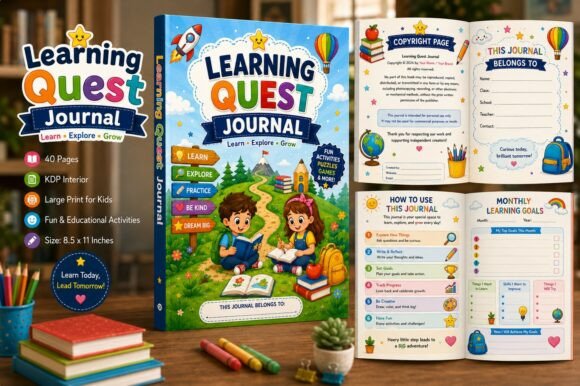
The Learning Quest Journal for Kids is structured around 40 pages of activities that integrate learning with personal development. It includes sections for setting learning goals across academic, personal, creative, and social domains. There are also “About Me” pages that encourage children to articulate their preferences, strengths, and experiences. Mood check-ins and positive affirmations are embedded throughout, providing regular opportunities for emotional check-ins and mindset reinforcement.
On the academic side, the journal offers alphabet tracing practice, number tracing, shape and color recognition exercises, count-and-circle activities, matching missing letter games, and sight word practice. These activities target early literacy and numeracy foundations in a low-pressure, interactive format. The PDF format, sized at 8.5 × 11 inches, makes it easy to print at home or in a classroom setting.
This combination of personal development and skill-building distinguishes it from many workbooks that focus solely on academic outcomes. The journal frames learning as a personal journey rather than a set of tasks to complete.
Reasons to Consider Learning Quest Journal for Kids
Several features make this journal particularly appealing for certain use cases:
- Goal setting in multiple domains: The inclusion of academic, personal, creative, and social goals encourages a well-rounded approach to growth. This can help children learn to prioritize and reflect on different aspects of their lives.
- Self-awareness and expression: The “About Me” pages and mood check-ins provide a gentle structure for children to develop self-knowledge and emotional vocabulary. For children who find it difficult to articulate feelings, these prompts can serve as a starting point.
- Confidence and resilience building: Positive affirmations are integrated in a way that promotes a growth mindset. Regular exposure to affirming language can help normalize self-encouragement and persistence.
- Foundational academic practice: The tracing, counting, matching, and sight word exercises offer repetition and practice that can reinforce early reading and math skills. The activities are varied enough to hold attention while staying focused on core concepts.
For families looking for a single resource that addresses both academic readiness and emotional well-being, this combination can be efficient and engaging.
Evaluating Benefits and Tradeoffs
Any tool carries both advantages and limitations. Understanding the tradeoffs helps set realistic expectations.
Benefits: The Learning Quest Journal for Kids encourages a routine of reflection and goal setting, which can build metacognitive habits early. The variety of activities reduces monotony, and the journal’s structure can help parents or educators create a predictable learning rhythm. The PDF format also allows for multiple uses—you can print pages as needed or reuse sections with different children.
Tradeoffs to consider: The journal is not a full curriculum. It is a supplement that assumes a child has access to other instructional materials or adult guidance for deeper learning. The activities are designed for early learners, likely ages 3 to 7, but the exact fit depends on the child’s developmental stage. Some children may breeze through tracing pages quickly, while others may need more support with sight words or goal-setting prompts. Additionally, because it is a printable PDF, there is no built-in digital interactivity—parent involvement is needed to print and facilitate use.
Another consideration is that the journal includes 40 pages. Depending on the pace of use, this could last several weeks to a couple of months. For those seeking a long-term daily resource, it may need to be paired with other materials.
Practical Considerations for Use
To get the most out of the Learning Quest Journal for Kids, a few practical points are worth keeping in mind:
- Age and readiness: The alphabet tracing, number tracing, and shape recognition activities are most suitable for preschoolers and kindergarteners. Older children may find these too basic, though the goal-setting and reflection pages could still be relevant for early elementary students if adapted.
- Involvement required: Some sections, especially goal setting and mood check-ins, benefit from adult conversation. A caregiver can help a child articulate their goals or discuss what they learned. This can be a bonding opportunity but does require time and attention.
- Flexibility in order: Pages do not need to be completed in strict sequence. You can prioritize sections based on the child’s current interests or needs. For example, if a child is working on letter recognition, the alphabet pages can be used more frequently.
- Printing and preparation: Since the files are PDF, ensure you have a reliable printer and paper. Laminate key pages or use sheet protectors for repeated use with dry-erase markers if you want to extend the resource.
Situations Where It Is a Strong Fit
The journal works well in several common scenarios:
- Supplemental home learning: For families who already have a core reading or math program, this journal adds a layer of personal development and reflection without duplicating effort.
- After-school or weekend enrichment: Short, varied activities can fit into small pockets of time. The mood check-ins and affirmations can be particularly useful for transitions between school and home.
- Homeschooling with a holistic focus: Homeschoolers who value social-emotional learning alongside academics may appreciate having a single resource that touches both areas.
- Travel or quiet-time activity: The printable format allows you to bring only the pages you need, making it easy to use during trips or while waiting.
- Classroom centers: Teachers could use the pages in learning centers, especially the tracing and matching activities, while using the reflection pages as part of morning meetings or end-of-day routines.
When Alternatives May Be Worth Considering
Not every situation calls for this type of journal. Here are scenarios where alternatives might serve better:
- If a full curriculum is needed: Families looking for a comprehensive scope and sequence for reading or math will need more structured programs. This journal is best used as a supplement, not a primary instructional tool.
- If digital interactivity is preferred: Children who engage better with on-screen activities might benefit from interactive apps or online platforms that offer similar goal-setting and skill practice with instant feedback.
- If a child is significantly older or younger: The content is designed for early learners. A child past the stage of letter formation and basic counting may find the tracing exercises unchallenging. For toddlers, the activities may require too much fine motor control and comprehension.
- If depth in one area is the goal: For a child who needs intensive practice in reading or math, a subject-specific workbook with more repetition and progression may be more effective than a mixed-activity journal.
- If print accessibility is limited: Without easy access to a printer, the PDF format becomes less convenient. In such cases, a pre-printed physical journal or notebook may be simpler.
Making a Decision
Choosing whether to use the Learning Quest Journal for Kids ultimately depends on what you hope to accomplish. If the goal is to introduce a habit of reflection, build emotional vocabulary, and reinforce early academic skills in a gentle, varied format, this journal aligns well. It is not intended to replace direct instruction, but to complement it in a way that makes learning feel personal and attainable.
Consider your child’s current stage and interests. Look through the 40 pages and ask whether they match the kinds of activities your child enjoys. Also assess how much time you can realistically dedicate to working through the prompts together. A resource like this works best when it is used consistently but without pressure to complete every page.
For those who value a balanced approach to early childhood development—one that addresses the whole child, not just academic milestones—the Learning Quest Journal for Kids offers a thoughtful and practical starting point. By focusing on both skills and self-awareness, it can help children see learning not as a series of tasks, but as a personal journey they actively shape.