Choosing the Right Space Learning Resource for Your Child: A Look at Fun Space Facts for Kids
When you are searching for ways to introduce a child to astronomy, the options can feel overwhelming. You might find yourself weighing the value of a structured ebook against the convenience of a YouTube video series, the interactivity of a science app, or the tactile experience of a printed encyclopedia. Each format has its own strengths, and the best choice often depends on the child’s age, attention span, learning style, and the environment you are creating at home or in the classroom.
One resource that has been gaining attention among parents and educators is Fun Space Facts for Kids, a 31-page educational ebook designed for young learners. This article will walk through what this ebook offers, how it compares to other common learning formats, and the practical tradeoffs you should consider before making a decision.
What Makes Fun Space Facts for Kids Distinct?
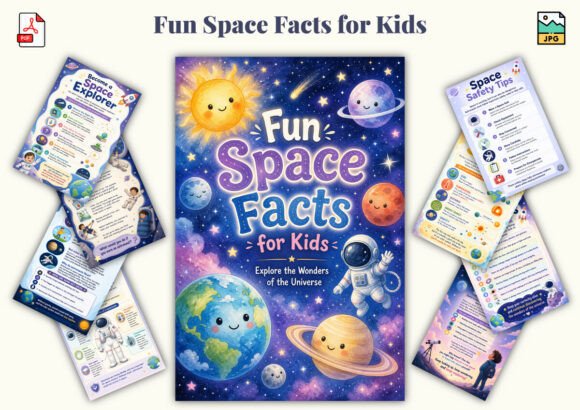
Fun Space Facts for Kids is a digital ebook that combines factual content about planets, stars, galaxies, gravity, orbits, and black holes with interactive elements such as quizzes, worksheets, and activities. The book is designed with a soft watercolor pastel theme and a clean, minimal layout, which makes it visually approachable without being distracting. It comes as a print-ready PDF and includes high-quality JPG pages, giving you flexibility in how you use the material—whether on a screen or printed out.
What sets this resource apart from many free online articles or short videos is its structure. Rather than offering isolated facts, the ebook presents information in a sequence that builds understanding. For example, a simple explanation of gravity might appear early, followed by a related activity that asks the child to apply that concept. This kind of scaffolding is common in well-designed educational materials but is often missing from loosely curated online content.
Another distinct feature is the mix of reading and doing. The worksheets and quizzes turn passive reading into active learning. For a child who learns best by writing, drawing, or answering questions, this format can be more effective than watching a video or scrolling through a website.
Comparing Formats: Ebook vs. Video vs. App vs. Physical Book
To understand where Fun Space Facts for Kids fits, it helps to compare it with other common learning tools.
Ebooks vs. Free Online Articles and Videos
Free resources like YouTube videos or NASA’s educational webpages are excellent for sparking interest. A five-minute video on how astronauts brush their teeth in space can be captivating. However, these resources often lack coherence. A child might watch a video about Mars one day and a clip about black holes the next, with no logical progression. Fun Space Facts for Kids offers a curated journey. Each page builds on the previous one, which can help a child develop a more connected understanding of space concepts.
The tradeoff is that an ebook like this requires a more active participation from the adult—you need to sit with the child, print pages, or guide them through activities. A video, by contrast, can be passively consumed while you prepare dinner. So if your goal is independent entertainment, a video series might be a better fit. If your goal is structured learning, an ebook tends to win out.
Ebooks vs. Science Apps
Interactive apps offer simulations, 3D models of planets, and even augmented reality features that let a child point a tablet at the ceiling and see constellations. These are powerful tools for visual and kinesthetic learners. However, many apps come with distracting advertisements, in-app purchases, or screen-time management challenges. Fun Space Facts for Kids is a static digital file. There are no pop-ups, no notifications, and no temptation to buy extra content. For parents concerned about digital clutter or commercial influence, a PDF-based ebook offers a cleaner experience.
The downside is that the ebook lacks the dynamic interactivity of an app. A child cannot rotate a 3D model of Saturn or zoom into a galaxy. If your child is highly visual and needs to see things move to stay engaged, an app might hold their attention better. For children who enjoy reading, coloring, and completing puzzles, the ebook format is often more satisfying.
Ebooks vs. Physical Books
There is something irreplaceable about a glossy hardcover space encyclopedia. Physical books allow for easy browsing, require no device, and can be read in bed without a screen. Fun Space Facts for Kids is designed as a print-ready PDF, so you can print it and turn it into a physical activity book. That gives you the best of both worlds—the convenience of a digital download and the option to create a paper resource.
However, printing 31 pages in color can be costly, and the final product may not have the same production quality as a professionally bound book. If you value sturdy binding, thick paper, and professional illustrations, a traditional children’s space book might be preferable. If you value flexibility—being able to print only the pages you need, reuse them with multiple children, or project them on a screen in a classroom—the ebook format is more practical.
Strengths and Tradeoffs in Practice
Let’s consider a few realistic scenarios.
Scenario 1: A homeschool parent covering a space unit. If you are teaching a structured curriculum, Fun Space Facts for Kids can serve as a standalone resource for a week or two of lessons. The built-in quizzes and worksheets reduce the time you need to spend creating your own materials. The soft pastel design also makes it relatively printer-friendly—it uses light colors, so ink consumption is moderate. A potential limitation is that if your curriculum requires in-depth coverage of specific topics, like the chemical composition of Jupiter or the history of space exploration, you may need to supplement with additional texts or videos.
Scenario 2: A classroom teacher with 25 students. The ebook’s JPG pages can be projected onto a whiteboard, making it easy to read together as a class. The worksheets can be printed for group work. The minimal layout ensures that even students with reading difficulties are not overwhelmed by dense text. However, because the ebook is designed for a general age range, you will likely need to adapt the activities for different skill levels. Some students may breeze through the quizzes, while others may need more guidance.
Scenario 3: A parent looking for a screen-free activity. If you are trying to reduce screen time, the print option is valuable. You can print the entire book and hand it to your child with a set of crayons. The fact that the book includes both reading and activities means a child can work through it independently for 20 to 30 minutes. The tradeoff is that you are responsible for printing and organizing the pages. If you lack a good printer or prefer zero preparation, a pre-printed book might be more convenient.
When Fun Space Facts for Kids May Be the Right Choice
This ebook is a strong candidate if any of the following apply to your situation:
- You want a cohesive, age-appropriate introduction to space that moves beyond random facts.
- You value active learning through worksheets, quizzes, and creative tasks.
- You need a resource that works both on-screen and as a printable.
- You are a teacher or homeschooler who wants ready-made materials without heavy preparation.
- You prefer a commercial-free, distraction-free digital product over apps or ad-supported websites.
When You Might Need Something Different
There are also clear situations where this ebook may not be the best fit:
- If your child is very young (pre-K) and needs large, simple images with very few words, a board book or a basic picture book may be more appropriate.
- If your child is older (middle school or above), the content may feel too basic. A more advanced encyclopedia or a documentary series would offer deeper knowledge.
- If your child struggles with reading and prefers audio or video explanations, an audiobook or a narrated space series could be more accessible.
- If you need a resource that aligns with a specific school curriculum or standardized test topics, you may need to verify that the ebook covers the required concepts at the necessary depth.
Practical Decision Factors
When evaluating any educational resource, it helps to consider a few key factors:
- Fit with your teaching style. Are you comfortable facilitating activities, or do you prefer a resource that can be used independently by the child? Fun Space Facts for Kids works best with some adult involvement, especially for younger readers.
- Device and printing capability. Because the ebook is a digital download, you need a device to view it and preferably a printer to use the worksheets. If you lack a printer, you will be limited to screen-based use, which may reduce the interactivity.
- Reusability. Since the worksheets are consumable (children write on them), you will need to print fresh copies for multiple children or repeated use. The digital format makes this easy, but it is something to budget for.
- Cost vs. value. Compared to a subscription to a science app or a single video course, the ebook is a one-time purchase. If you compare it to a full library of space books, it is far more affordable. But if you only need a quick overview for a one-time lesson, a free online article might suffice.
Making an Informed Choice
No single resource can do everything. Fun Space Facts for Kids offers a thoughtful blend of factual content and interactive activities in a clean, child-friendly design. It is particularly well-suited for structured learning environments where an adult can guide the child through the material. Its strength lies in its coherence and the active learning it encourages.
At the same time, it is not a replacement for immersive videos, dynamic apps, or comprehensive encyclopedias. The best approach for most families is to use a mix of resources. You might use the ebook as the backbone of a space study unit, supplementing it with a short documentary on planets and a visit to a local planetarium. That combination gives a child both depth and variety.
By understanding what this ebook offers and where it fits among other options, you can make a choice that aligns with your child’s needs, your teaching style, and the practical realities of your home or classroom.