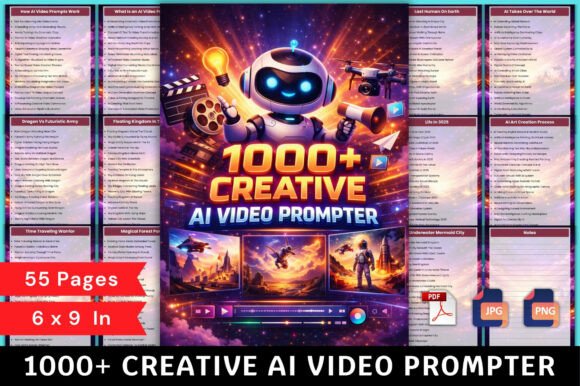
🎬1000 Creative AI Video Prompter: A Strategic Prompt Library for Consistent, High-Impact AI Video Production
Creating video content with AI tools has never been more accessible, but raw access doesn't guarantee quality, consistency, or strategic alignment. The gap between generating a random AI video and producing one that resonates with an audience often comes down to the prompt itself—its structure, its intent, and its fit with the platform and goal. 🎬1000 Creative AI Video Prompter is a professionally organized collection of 1,000 prompts designed to bridge that gap, offering clarity and structure for anyone who wants to use AI video generation not as a novelty, but as a repeatable creative process.
This is not a list of whimsical ideas. It is a system—52 topics, each with 20 focused prompts—that spans from foundational concepts to advanced cinematic techniques, commercial storytelling, and genre-specific production. Whether you are testing AI video for a brand campaign, building a short-form content channel, or exploring narrative experiments, this library provides a structured starting point that can save hours of ideation time while raising the baseline quality of your output.
Why a Structured Prompt Library Matters for Production Goals
When you sit down to create an AI video, the prompt you feed into the tool is the single most influential factor in what comes out. A vague prompt yields a generic result. But when prompts are organized by intent, genre, and desired emotional tone, you reduce guesswork and increase the likelihood that the output aligns with your specific need.
The value of 🎬1000 Creative AI Video Prompter lies in its structural logic. Each topic area is carefully curated to support a specific creative or commercial objective. For instance, if you need a short cinematic trailer for a product launch, you can go directly to the cinematic storytelling section and find prompts optimized for dramatic pacing, visual depth, and emotional beats. If you need science fiction visuals for a brand concept, the sci-fi section provides ready-to-use language that includes references to lighting, texture, motion, and scale.
This means you spend less time thinking about what to type and more time evaluating, iterating, and refining the output toward your goal. For content creators operating on tight schedules—daily YouTube Shorts, weekly Reels, rapid prototyping for client pitches—this workflow can be a decisive productivity advantage.
Aligning Prompts with Platform and Audience Strategy
One of the more subtle challenges in AI video creation is that a prompt that works well for a 30-second Reel may produce a disjointed result when stretched to a 60-second YouTube Short. Similarly, a prompt designed for TikTok's fast-moving, vertical format may feel flat in a widescreen cinematic render. 🎬1000 Creative AI Video Prompter addresses this by organizing many prompts with short-form, platform-friendly constraints in mind. The language used in the prompts is tuned for pacing, visual impact, and narrative density that suits quick consumption—which is exactly what platforms like Reels, Shorts, and TikTok reward.
This alignment is not accidental. The prompts are built to evoke clear visual sequences, emotional transitions, and distinct aesthetic moods within a compressed timeframe. If you run a brand that needs to maintain a consistent visual identity across multiple short-form videos, using a structured prompt set like this helps ensure that each piece of content carries the same underlying creative tone, even when the specific subject changes.
Practical Use Cases for Entrepreneurs and Small Teams
🎬1000 Creative AI Video Prompter is not exclusively for professional filmmakers or large media operations. In fact, some of its most effective applications are found in smaller teams where resources are constrained and creative capacity is spread thin.
- Product concept visualization. If you are developing a new product and need to communicate its mood or use case to stakeholders or early testers, you can use prompts from the commercial and lifestyle sections to generate quick concept videos without hiring a production crew.
- Internal communication and training. The business and motivational topics provide prompts that can be adapted for internal updates, team vision videos, or training scenarios—especially useful when you need to create visual context quickly for distributed teams.
- Brand storytelling at scale. For content marketers who need to produce a steady stream of video assets across multiple campaigns, having a categorized prompt library allows for batch creation. You can generate several video concepts in one session, review them, and select the strongest direction for further refinement.
- Client pitches and proposals. Freelancers and agencies can use the cinematic and futuristic prompt sets to create mood videos that accompany written proposals. A short AI-generated video that evokes the desired brand atmosphere can be more persuasive than a deck slide alone.
How to Approach This Library with Intent
The most common mistake when using any prompt collection is treating it like a slot machine—pull a prompt, generate a video, and hope for magic. The real value comes when you approach it like a creative brief. Before you open the library, take a moment to clarify the purpose of the video you want to create.
Ask yourself: What emotion should the viewer feel in the first three seconds? What visual mood best supports the message I am communicating? What platform will this live on, and what technical constraints does that platform impose?
Once you have answered those questions, you can browse the relevant topic section with a more discerning eye. For example, if you are creating a short video about a startup journey, the business and storytelling sections offer prompts that emphasize progression, overcoming obstacles, and visionary outcomes. You might select a prompt that includes visual cues like "ascending light," "wide landscape with a lone figure moving forward," or "transition from muted tones to saturated color."
Then, instead of accepting the first generation, treat it as a prototype. Adjust the prompt slightly—change a lighting descriptor, swap a color palette, alter the pacing reference—and generate again. This iterative approach, grounded in an initial structured prompt, is where the real craft begins. The library gives you a reliable starting point; your judgment refines the result into something that fits your specific context.
Long-Term Value: Building a Consistent Creative Voice
One of the underappreciated benefits of working with a structured prompt library over time is that it helps you develop a more consistent creative voice. When you repeatedly use prompts that are organized around similar aesthetic principles, you naturally internalize those principles. Over weeks and months, you may find yourself needing the library less frequently because you have absorbed the patterns and can adapt them to new situations.
This is not a dependency problem—it is a learning process. The collection functions as a reference text for the language of AI video generation. By seeing how prompts are constructed for different genres, moods, and commercial contexts, you build a mental toolkit that transfers to any AI video tool you might use in the future.
For small business owners and creators who handle multiple aspects of their operation, this type of internalized knowledge is a long-term asset. It reduces the friction of creative execution, allowing you to move from concept to output more fluidly as your content needs evolve.
Risks of Using a Prompt Library Without Clear Context
It is important to acknowledge that even the best structured prompt set can produce disappointing results if applied without a clear strategic frame. The primary risk is generating videos that are visually interesting but thematically disconnected from your message. A dramatic cinematic sequence may gain attention, but if it does not reinforce your core idea, the viewer may remember the spectacle and forget the point.
Another risk is over-reliance. If you use the library exclusively without developing your own prompt instincts, your content may start to feel formulaic, especially if you produce a high volume of videos using the same topic sections repeatedly. The solution is to treat the library as a creative partner, not a replacement for strategic thinking. Use it to generate options, but always filter those options through the lens of your specific audience, platform, and goal.
There is also a practical risk related to tool compatibility. Different AI video generators interpret prompt language differently. A prompt that works well in one tool may produce a confusing output in another. It is wise to test a few prompts across the tools you use before committing to a production workflow. The structure of 🎬1000 Creative AI Video Prompter is platform-agnostic, but your tool's particular rendering style and prompt sensitivity will influence final results.
Strategic Observations for Decision-Makers
If you are evaluating whether to invest time in this prompt library, consider the specific demands of your content operation. For solopreneurs and small teams who need to produce consistent video content but lack dedicated creative staff, the main advantage is time compression. Categorizing 1,000 prompts into 52 focused topics means you can explore a wide range of creative directions in a single session, rather than piecing together ideas from disparate sources.
For marketers and brand managers, the value is in repeatability. When a campaign needs a series of video assets that feel coherent, having prompts organized by mood and genre allows you to maintain visual consistency across the entire set. You can identify which prompt families produce results that align with your brand guidelines and return to them with confidence.
For educators and trainers, the collection offers a way to demonstrate visual concepts quickly. If you are teaching storytelling, digital media, or AI tools themselves, having a categorized prompt set gives students a structured way to experiment and compare outputs across different genres and emotional tones.
The library also supports long-term content planning. By reviewing the available topics, you can map your content calendar weeks in advance, selecting prompt categories that align with seasonal themes, product launches, or narrative arcs you want to explore. This turns AI video generation from a reactive, ad-hoc activity into a planned, strategic function.
Grounded Recommendations for Getting Started
If you decide to integrate 🎬1000 Creative AI Video Prompter into your workflow, start with one topic area that directly maps to a current project. Do not attempt to explore the entire library at once. Pick three to five prompts from the section most relevant to your immediate need, generate videos for each, and compare the results. This focused approach gives you direct evidence of how the prompts perform with your chosen tool, and it builds confidence in the system before you scale up.
Keep a simple log of which prompts produced outputs that aligned with your goal and which ones required significant modification. Over time, this record becomes a personalized reference that accelerates your decision-making further.
Finally, remember that AI-generated video is a tool for communication, not a substitute for strategic thinking. The most effective videos—whether generated by AI or filmed traditionally—are those that serve a clear purpose, speak to a specific audience, and deliver a message that matters. 🎬1000 Creative AI Video Prompter gives you a structured foundation for that work, but your judgment, context, and creative intent remain the defining factors of success.